VM03572-21h 6150x4100 pixels 3 frame 50 shot focus stack blend a6700 56mm
enlarged vertical slice view image text section
NEXT: Page 6 San Jose Municipal Rose Garden 4/14 2of2
2026 Trip Chronicles: Contents
San Antonio River basin 3/27
San Jose Municipal Rose Garden 4/13 1of2
Eight days after returning from Carrizo Plain on March 19, given a weather forecast for relatively calm early mornings within the San Antonio River Basin, a headwaters area of the Salinas River, I was again on the road at dawn on Friday March 27, 2026. I drove in light commute traffic, 130 miles south on US101 to San Ardo, whereupon took the Paris Valley Road west to maintained dirt Lockwood - San Lucas Road and west up into the hills through private ranch lands that reaches a 2160 foot pass within BLM recreation lands designated Williams Hill. The dirt road through its lowest more level miles, probably due to the nature of ground up depths of its fine marine sedimentary geology, is maybe the dustiest road I've ever driven, causing massive clouds of dirt to rise. All the dense vegetation roadside was thickly covered in the dirt.
Very few wildflowers showed along the road until beyond the pass, dropping several hundred feet down into Pine Canyon. The below BLM brochure link has a map that shows where the public lands are. Between 1330 and 1380 feet is a short section of unfenced, unsigned BLM land where abundant wildflowers grow after wet winters. I reached this area about 7:15am PDT, parked and was soon roaming about. There was an abundance of species that had risen up from the mid February storms, however due to the long March drought period, many plant stems had collapsed down due to a lack of adequate root soil moisture. At this early time of morning, this north facing canyon side is shadowed that causes several species like creamcups and baby blue eyes remained closed up until sun rises more. That was a problem because early was nicely dead calm while an upcanyon breeze was likely to develop as the valley to the west warmed up in morning sunlight, expanding its airmass that then pushes air up surrounding canyons.
Williams Hill BLM lands
VM03429-40h 6100x4100 pixels 1 frame 12 shot focus stack blend a6700 17-40mm @17mm
enlarged vertical slice view
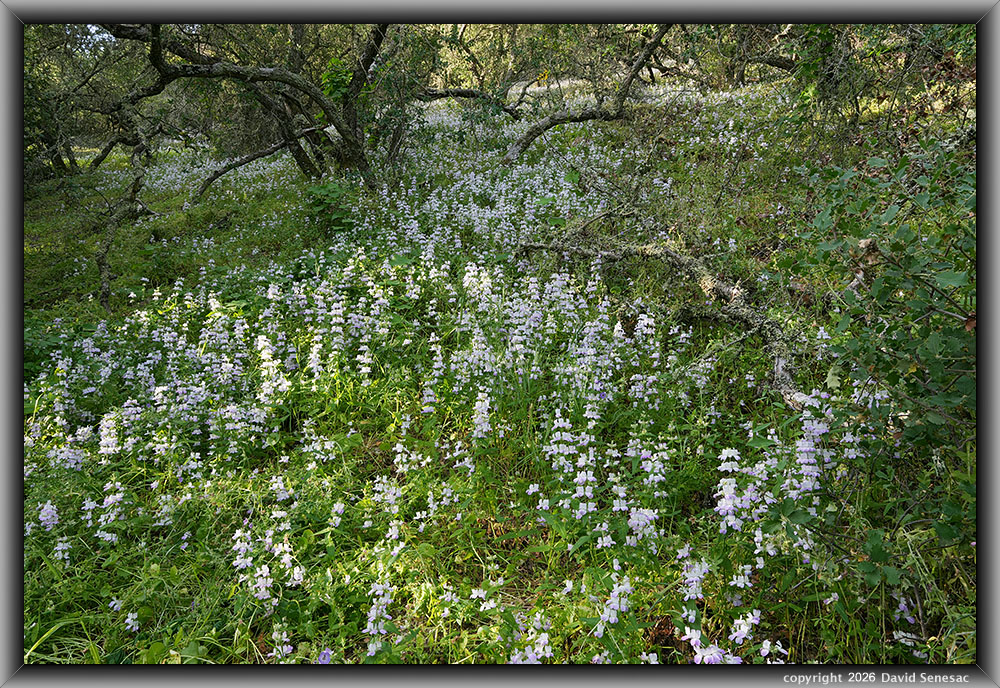
I set out with my camera gear, then at 7:29am PDT worked these purple Chinese houses, collinsia heterophylla, that were abundant in this region. Unlike the Sierra Nevada variety, they are more whitish than purple. Also in the mix of plants with collapsed stems, are miner's lettuce, Claytonia perfoliata, blue fiesta flower, Pholistoma auritum, California grape, Vitis californica, and California scrub oak, Quercus berberidifolia, the new leaves of which are at frame right. Much crustose and foliose lichen, nicely adorned all these oaks. The top of the canyon ridge there, was only 500 feet higher, so sunshine was already poking into areas of my frame above. I had to be careful where I walked because there was scattered poison oak amid a dominant scrub oak woodland. The above image with my zoom at 17mm used 12 focus bracket shots.
VM03469-87v 4100x6150 pixels 1 frame 19 shot focus stack blend a6700 17-40mm @40mm
enlarged vertical slice view
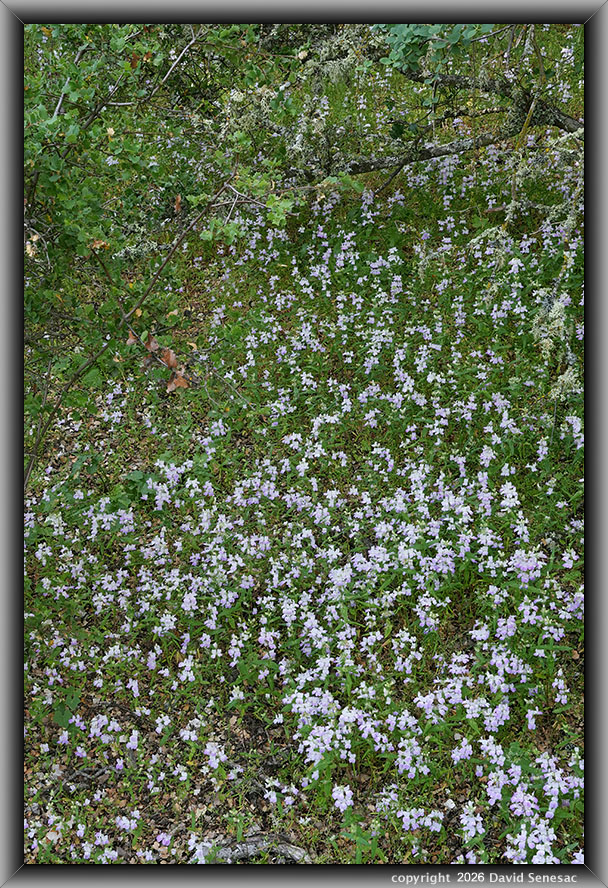
This next image at 7:43am using 19 shots, shows the same species. I love how my a6700 automated Focus Bracket function can capture such intricate intimate subjects with many parallax elements and considerable depth of field between adjacent subject elements.
VM03499-10v 4100x6100 pixels 1 frame 12 shot focus stack blend a6700 17-40mm @28.8mm
enlarged vertical slice view
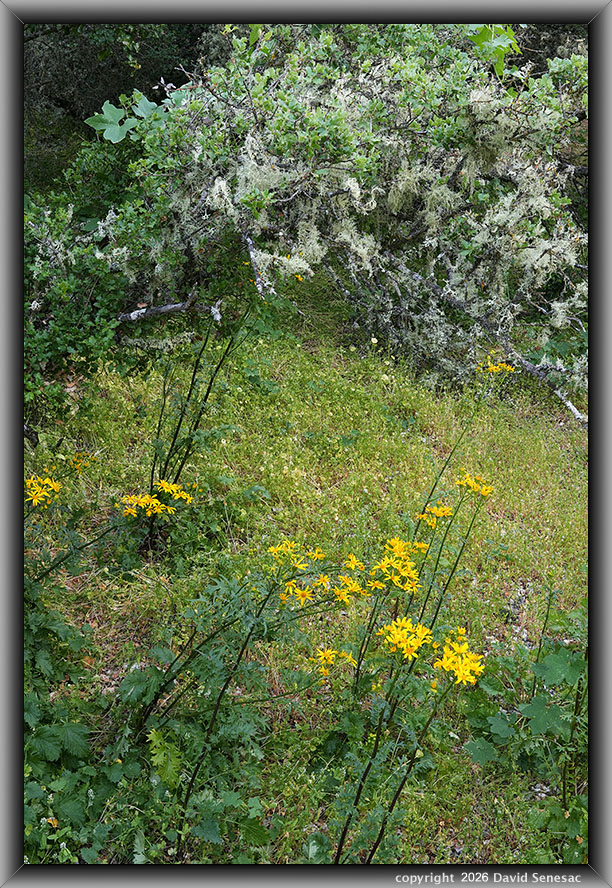
A more showy species common in the area is Brewer's butterweed, Packera breweri, here along with much drying miner's lettuce, California grape, California scrub oak. At lower frame are white hued shortspur seablush, Plectritis congesta ssp. brachystemon.
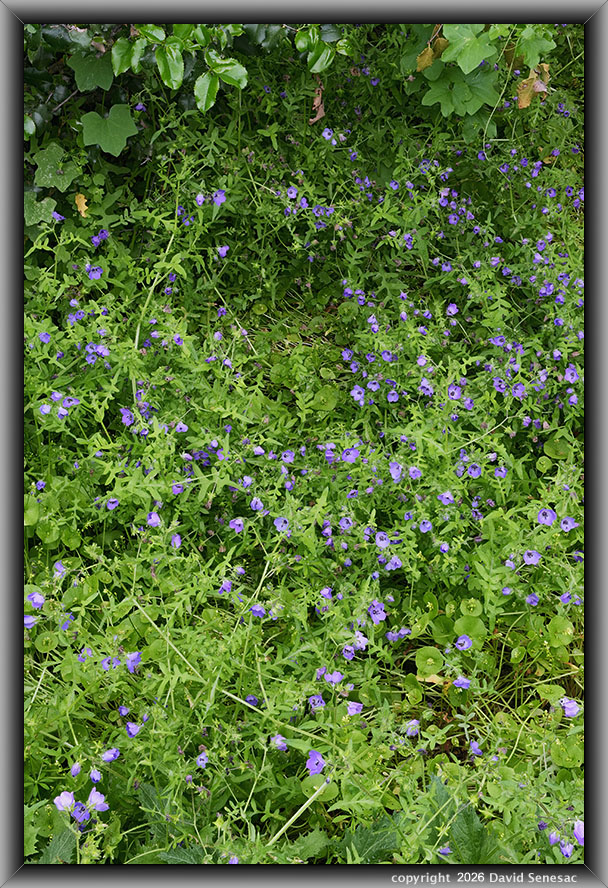
VM03511-42v 4100x6150 pixels 1 frame 32 shot focus stack blend a6700 17-40mm @40mm
enlarged vertical slice view
A lush ground level jungle using 32 shots, dominated by blue fiesta flower and miner's lettuce, with at frame top, leaves of California grape, and California scrub oak.
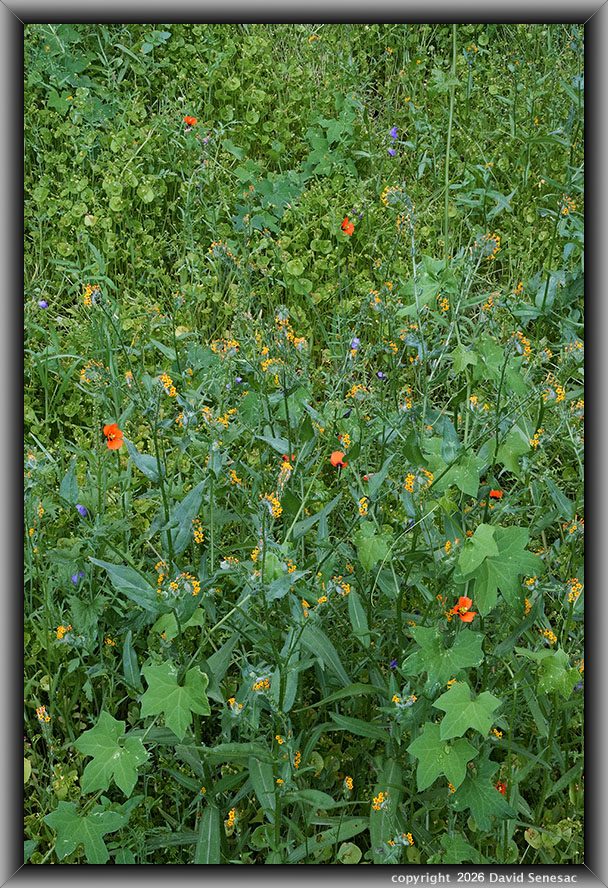
VM03543-71v 4100x6150 pixels 1 frame 29 shot focus stack blend a6700 17-40mm @40mm
enlarged vertical slice view
These slopes had some pretty wind poppy, Papaver heterophyllum, here worked at 7:59am, mixed with another lush jungle of Douglas's fiddleneck, Amsinckia douglasiana, miner's lettuce, and blue fiesta flower. Note the large leaves of California grape.
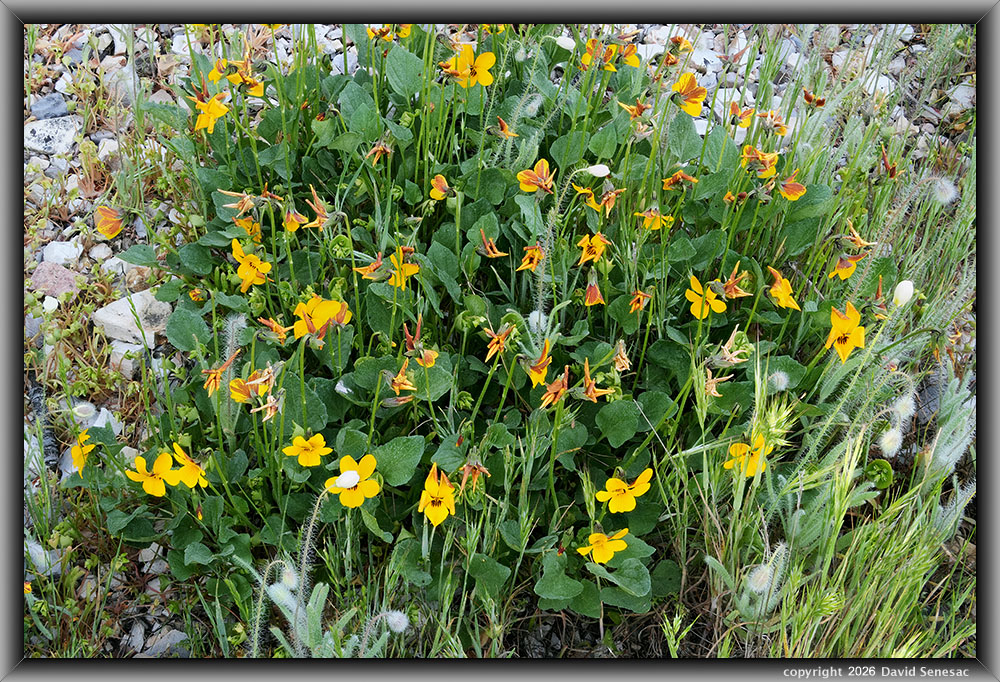
At page top, my last subject this morning at 8:08am of California violets, Viola pedunculata, still closed up creamcups, Platystemon californicusand, miner's lettuce, among erosion debris of white sedimentary stones. A continuous breeze had indeed arrived. I tried to work more flowers hereabouts and in other roadside areas of the basin, however the breeze made post processing impossible.
I drove to the Jolon Road areas I'd worked baby blue eyes the week before, but the flowers had noticeable dried and the breeze was too strong to bother. Next through Hunter - Liggett Miliary Reservation, I drove out to Santa Lucia Memorial Park that requires a wet ford in the San Antonio River that helped wash away much dirt I'd picked up on dirt roads. Not many flowers in that zone. Then later from Greenfield drove west on East Carmel Valley Road to Pacific Grove where I spent a few hours along the rocky shores having fun before late in the day driving the 70 miles back home.
This is the seventh year I've done photography at the San Jose Municipal Rose Garden, that began in April 2020 when the COVID-19 pandemic began with a Santa Clara County policy of sheltering in place, staying within our county. I quite enjoy the "treasure hunt" for most aesthetic rose subjects. Not all pretty roses are in situations they may make worthwhile photographs. A subject needs to fit within a rectangular frame. Because I focus bracket requiring identical registration between shots, flowers need to be still or nearly so. And I need to be able to considerately position my tripod and its head with my Sony a6700 camera, without touching other rose bushes. The following are my web pages for those previous year's work:
2020 SJMRG page 2
2020 SJMRG page 3
2021 SJMRG page 2
2021 SJMRG page 3
2022 SJMRG page 1
2023 SJMRG page 5
2024 SJMRG page 3
2024 SJMRG page 4
2025 SJMRG page 3
The following are 3 links to the San Jose Municipal Rose Garden web pages:
San Jose city, San Jose Municipal Rose Garden web page
San Jose Municipal Rose Garden rose plot map
Friends of the San Jose Rose Garden
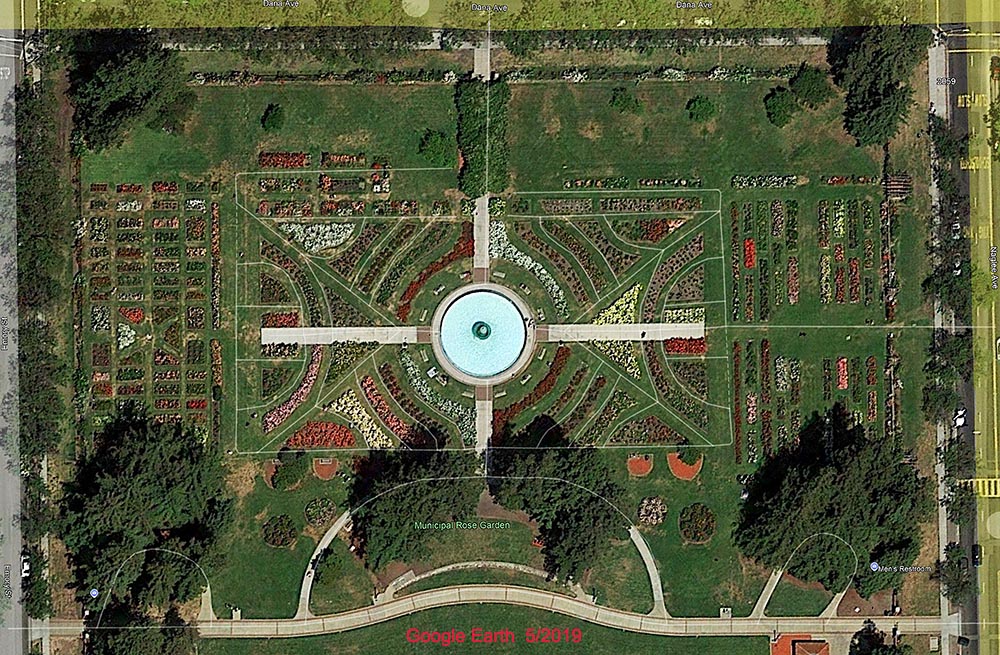
Due to the unusual Northern California winter weather in 2026 that had 3 long warm dry spells between 2 strong storm periods without small storm periods, wildflowers throughout the state bloomed 2 to 3 weeks earlier than normal and so did roses in this garden. Garden workers mentioned they had not done anything different this year as all roses cultivars developed on their own early. I also noticed some cultivars went through their flower to seed cycles more rapidly.

VN03772-03h 6150x4100 pixels 1 frame 32 shot focus stack blend a6700 30mm
enlarged vertical slice view
I found conditions at the garden on my first visit on Monday April 13, 2026, appeared like the usual end of April. It had lightly rained in the wee hours, so roses everywhere were wet with water droplets. On many days, some roses are wet during the early morning hours I tend to visit during when breezes are often calmest, because of overnight water sprinklers. Even when running, the sprinklers only wet roses in limited plot areas. I went right to the Rainbow Sorbet cultivar plot where I have worked more rose subjects than on any other plot. There at 8:17am PDT, worked this group of roses subject that from some positions appeared as flowers around a ring of green leaves.
Per FOSJRG: Rainbow Sorbet, Floribunda. Deep pink, yellow edges. Mild, sweet fragrance. 18 petals. Average diameter 3.5 inches. Continuous (perpetual) bloom throughout the season. Pointed, ovoid buds. Edged in deep pink, this golden yellow beauty blooms early and abundantly and continues all season long. Remarkable disease-resistance and very winter hardy. Medium green foliage. Height of 4 feet to 5 feet (120 to 150 cm). Hybridized by Ping Lim and Jerry F. Twomey Parentage: Playboy and Earth Song.
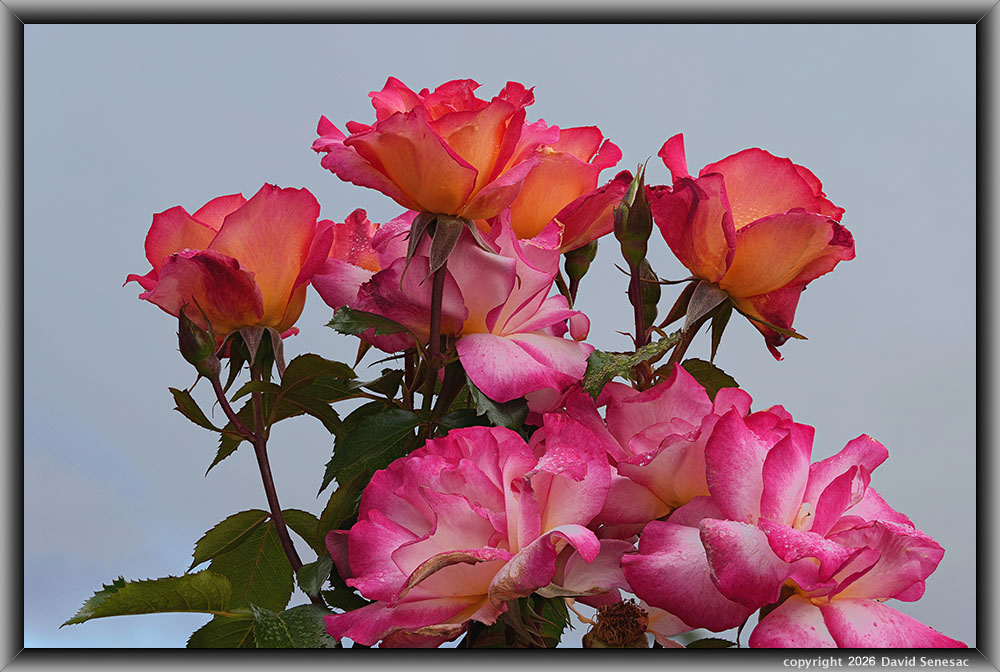
VN03833-56h 5800x3800 pixels 1 frame 24 shot focus stack blend a6700 56mm
enlarged vertical slice view
A second Rainbow Sorbet cultivar that I put up against the darker gray storm clouds at 8:36am. Only a few rose plants in the garden stick up higher than like roses in given plots and those that do given they are more apt to be in any breezes, can only be worked in focus bracket mode during calmest conditions. And even fewer are positioned in ways one might position a camera on a tripod to put a group of flowers up against the sky since trees and other elements are behind most plots.
When I set up these images in a6700 focus bracket mode, a critical part of that process is focusing on the nearest element in a frame that is where its focus starts at then increases, If any elements are closer, they won't be in focus. To save battery power, I am constantly turning the camera off after performing any shots. When powering back up, the a6700 comes up in Auto Focus mode. Thus, will often press the shutter release button half way at the image zone where I see a nearest point. I then switch to Manual Focus via a Custom function button and turn the 56mm lens barrel focusing ring that then magnifies that position in the Electronic Viewfinder. I then carefully adjust the exact focus to the nearest element. I've learned for plant close-ups, using an F8.0 aperture instead of sharpest F5.0, tends to make Zerene Stacker in Edit mode less tedious and without parallax out of focus blooming edge issues, while sharpness is trivially different for this kind of subject.

VN03869-08h 5900x3600 pixels 1 frame 40 shot focus stack blend a6700 56mm
enlarged vertical slice view
At 8:48am, I was also able to position up against the gray sky, these Fired Up cultivar roses, that back lit, often look like the orange reddish hues of fire.
Per FOSJRG: Floribunda. Bred by Alain Meilland (1940). Introduced in United States by Meilland-Star Roses Inc. in 2014 as 'Fired Up'. Orange, yellow stripes, ages to orange-red. None / no fragrance. up to 10 petals. Average diameter 3 inches. Medium, semi-double (9-16 petals), cluster-flowered bloom form. Blooms in flushes throughout the season. Upright. Glossy foliage. Height of 4 feet to 5 feet (120 to 150 cm).

VN03933-82h 3800x3500 pixels 1 frame 50 shot focus stack blend a6700 56mm
enlarged vertical slice view
The rose plants in this Hot Cocoa plot are rather low to the ground where sprinklers tend to only be pointed at. Thus, are often wet early mornings that herein shot at 9:14am. But this was after natural rain. A rather unusual brownish red rose hue. The white areas are snail mucous. The garden has a major snail population because the garden management doesn't use pesticides, especially because visitors like this person, loves to put their noses up against recently opened flowers to smell their fragrance.
Per FOSJRG: Hot Cocoa Russet Floribunda. 'Hot Cocoa': Tom Carruth's new floribunda is this year's most talked about rose, the one causing the most drooling and mass hysteria. The color is outrageously, heart-stopingly gorgeous, though it seems to vary with temperature, time, and the eye of the beholder. I've seen it described as cinnamon, brick, russet, smoky, and rich chocolate-orange with a purple-burgundy cast. Stand back and let me through! Those of us who lust after coffee colored roses have run ourselves ragged in the past, fussing over pathetically wimpy hard-to-find twigs that looked like death warmed over by mid-summer. But not 'Hot Cocoa'!
Rosarians who've grown it in test gardens are raving wildly about its health, vigor, and ability to hold color in heat. Exhibitors, arrangers, and organic gardeners alike are applauding the lush healthy foliage, fruity fragrance, and fast repeat bloom. I'll be putting six in my day lily beds. Russet. Mild, fruity fragrance. 25 to 30 petals. Average diameter 4 inches. Large, double (17-25 petals), cluster-flowered, in small clusters, ruffled bloom form. Blooms in flushes throughout the season. Height of 42 inches (105 cm). Width of 4 feet (135 cm). Hybridizer: Tom Carruth (UnitedStates, 2002) Parentage: seed: Playboy x Altissimo pollen: Livin' Easy

VN04001-50h 5800x3800 pixels 1 frame 50 shot focus stack blend a6700 56mm
enlarged vertical slice view
At 9:26am, an even more unusual brown rose hue above with the cultivar named Koko Loco. Notice areas of purple as the brown hue is a combination of the purple color.
Per FOSJRG: Koko Loko. Mauve or mauve blend Floribunda. (PPAF) Milk chocolate and lavender? You have to see it to believe it! It's hard to imagine a milky chocolate-colored bud maturing to a solid soft lavender blossom. The transition is so unusual and actually quite beautiful. The chocolate is creamy, like latte, but the latte goes 'loco' and finishes fully lavender. The blooms have impeccable show form and are long-lasting on the plant and in the vase. Rounded, bushy plants are chock full of deep green leaves that stay clean and healthy. Beyond its novelty, this is a great plant! Flower Size: 3-1/2 to 4-1/2 inches. Fragrance: Mild. Hybridizer: Bedard, 2012. Milky chocolate suffusing to unusual lavender. Mild fragrance. 30 to 35 petals. Average diameter 4.5 inches. Medium-large, full (26-40 petals), cluster-flowered, in small clusters, classic hybrid tea, high-centered bloom form. Prolific, blooms in flushes throughout the season. Long, pointed buds. Medium, bushy, rounded. Medium, semi-glossy, medium green foliage. Height of 30 inches to 35 inches (75 to 90 cm). Hybridizer: Christian Bedard (United States, 2010). Parentage: Seed: Blueberry Hill. Pollen: Pot O'Gold
NEXT: Page 6 San Jose Municipal Rose Garden 4/14 2of2
2026 Trip Chronicles: Contents








