
UZ03560-03567-3x1v 8800x6000 pixels 3 column 1 row 3 frame 8 shot focus stack stitch blend a6700 30mm
enlarged vertical slice view image text section
NEXT: Page 6 Eastern Sierra
2025 Trip Chronicles: Contents
Green Creek Backpack 7/27
Green Creek Backpack 7/28
Green Creek Backpack 7/29

(Continuation from Page 4.) Sunday, July 27, 2025, day 4 of our trip, both Jn and I arose early to hopefully capture good sunrise light; however, there were no morning clouds, as a drier air mass had moved in that would provide us with mostly sunny skies for the rest of our trip. Js and I packed up gear at our usual familiar rate, while Jn, dealing with much unfamiliar gear in his large pack, took much longer, which annoyed Js, eager to leave and reach East Lake. We got on to the trail and made good progress.
At the Green Lake outlet, I used an easy log jam crossing. Then we slowly made our way uphill to the north outlet end of East Lake at 9470 feet; that was 2.4 miles with 740 feet of uphill and 250 feet down. Jn's taped boots had held up, and he was becoming steadier crossing streams that usually require using poles or sticks for support, stepping on slippery rocks both above and below water, plus placed tree branches. When it was more difficult, I'll extend the legs of my big tripod.
We reached the tentative camp zone west of the outlet stream at East Lake by late morning. I explored around for a camp spot with a lake view, but just as I recalled from our 2024 trip, there were none without climbing up the slope too high, too far from water sources, and without lake views due to the blocking lodgepole pine forest. We thus settled on a primitive zone I did check out last year further down the outlet stream while up above, and view shielded from the trail and creek. Cascading water sounds down at the creek also isolated any sounds we would make from those possibly hiking its adjacent trail. In any case, our two camp locations on this trip were admittedly quite boring, though expected for this quickly planned easy trip at lower forest elevations.
In the future, it will also be where I expect to site a camp, as it worked well. Although maybe just 50 feet vertically and 200 feet horizontally above the creek and trail, it always surprises me how the vast majority of visitors never find such sites and rather tend to site against policy, right atop or within sight of trails or minimally close to lake edges or streams. East Lake has an old rock outlet dam with a large campsite on the east side of the outlet stream. That camp spot has been signed for NO CAMPING, so it is recovering.

I set up my tent and gear quickly per the image above right. Our water supply was about 50 feet down the hill just above a rock step across the trail crossing. Note, as usual, I rarely filter my water, so this was essentially right out of the lake. Down at the creek's vegetation, there were many more mosquitoes than we had at Green Lake, but just above where we camped in the dry forest, they were few enough that I never bothered to apply DEET over our last 3 days.
I hiked over to the northwest shores of East Lake to fish. There, I soon caught 3 sizeable eastern brook trout that I released since I had plenty of freeze-dried meals and had already fried up a meal of fish on day 2, with my interests this day more about climbing up above the lake to a view location Js and I had discussed. If we had reached the lake a couple of hours earlier at mid-morning, I would have probably kept the fish and fried up another lunch. Js arrived, joining me to fish. I returned to camp, then cooked my Mountain House Stroganoff and Beef freeze-dried meal. For the rest of the trip, I would not make time to fish again. Interestingly, the silver Kastmaster I tied up on day 2 was never lost, though it did snag up a few times that I was able to extract. I never had a single monofilament 4-pound test line or reel tangle, haha.

Image of one fat 10.5-inch female eastern brook trout caught on the silver Kastmaster and then released. To unhook and release trout, I have small needle-nose pliers that I grab one of the lure treble hook shafts with, invert it, and that magically releases the fish 95% of the time.
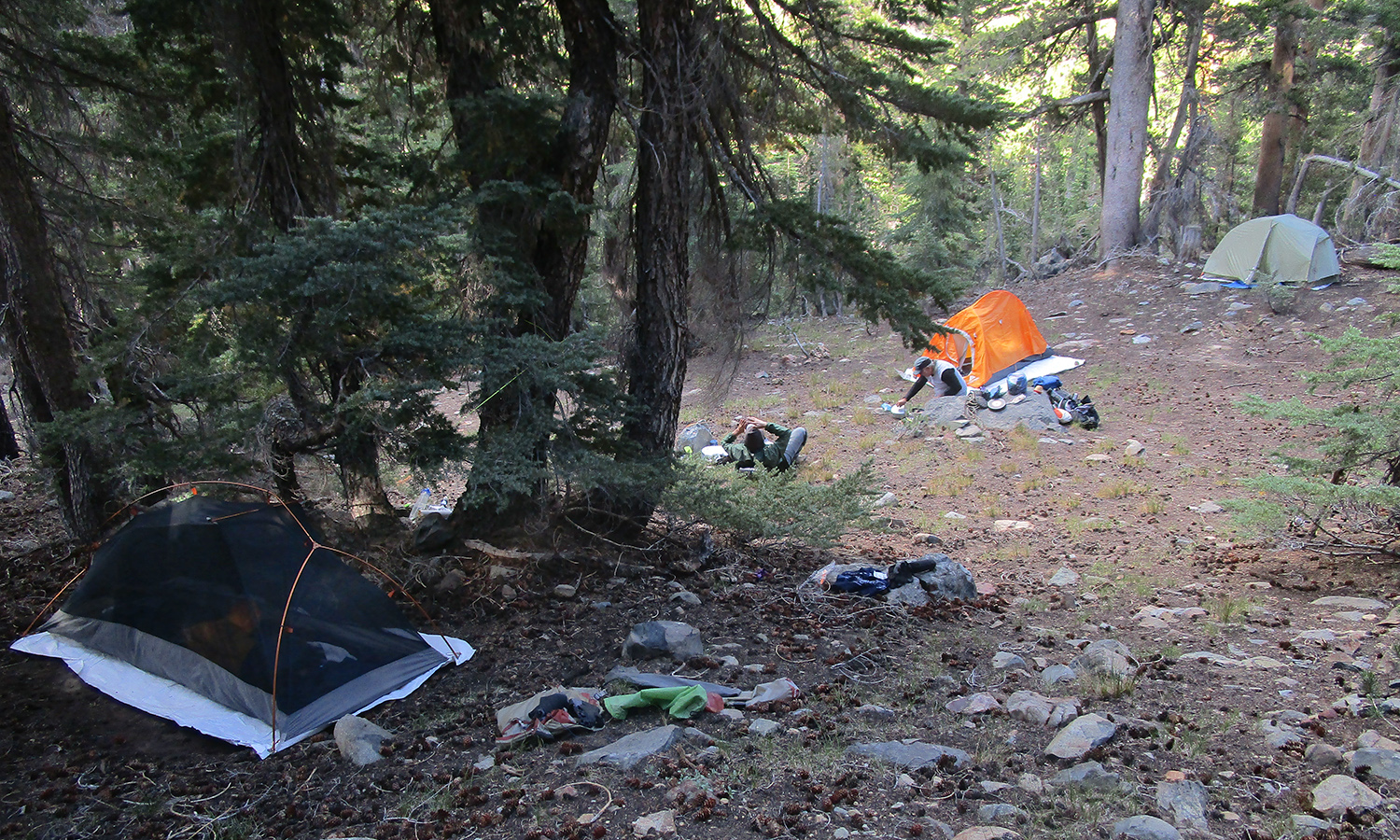
Per the above image, our East Lake camp. Js's tent, lower left, shaded by a mountain hemlock, was later moved down below Jn's orange tent. On a web board, I often read requests from others asking for locations for campsites along trails. Yikes! 95% of wilderness landscapes have ENDLESS possible usable primitive camp spots if one simply bothers to look about well away from trails or lake edges. If one does site near trails or lake edges, one ought to use established camps instead of making new ones.
Although many visitors make a big deal of tenting sans ground cloths atop totally level, picked-clean, well-used sites, I rarely do so, nor leave such in a way one might be able to tell a month later other than a lack of loose pine cones, that anyone tented so. A branch broom brush quickly sweeps away loose pine cones. I use a cheap Tyvek sheet atop primitive flat, reasonably level spots, as this lightweight person sleeps well on awkward surfaces that are abundant.

UZ03495-31 3000x3700 pixels 1 frame 37 shot focus stack blend a6700 56mm
enlarged vertical slice view
Mid-afternoon, while Js and Jn fished East Lake north shores with nice action, I climbed up 300 feet above camp to a superb overlook of the East Lake basin. From our camp, I'd found an old deteriorated horse packer trail that had not been used in years. About 100 feet above our camp, it led to a bench with a couple of old campsites. Continuing on the ducked route, I came across an uncommon candystick, aka sugarstick, Allotropa virgata, a plant that belongs to the mycoheterotrophs group of plants that feed off fungi, organic nutrients produced within the roots of what is probably a nearby mountain hemlock. Unfortunately, I needed to climb higher for photos; it was a windy day, so I could not get a good focus bracket photo, and the light through the forest was mediocre. Thus, the above was all I managed. Candystick gets its name from the red and white, peppermint candy-like stalk.
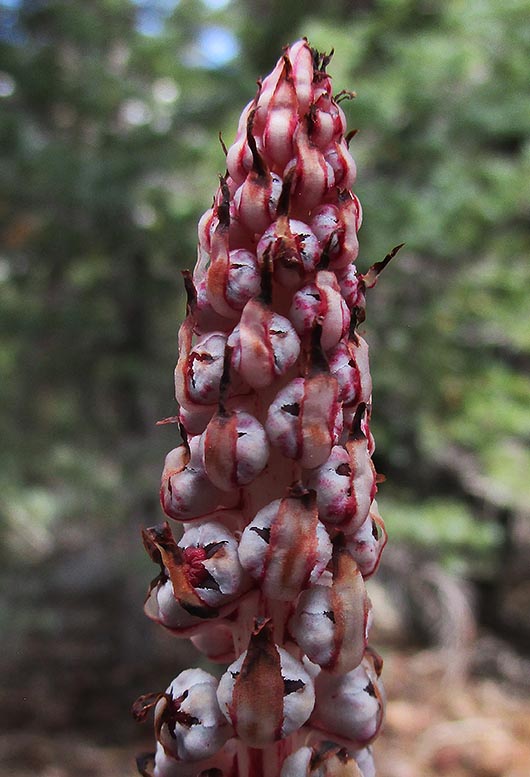
A candystick close-up of the top of the plant taken with the ELPH190. Also love its star-like flowers. Isn't nature amazing!
Continuing up through the forest, I reached the open views talus zone below the east face of 11000+ foot Gabbro Peak where I set up for some photos. At page top, the east side of deep East Lake below, with 12374 foot rusty metamorphic Dunderberg Peak and granitoid 11.4k-foot Kavanaugh Ridge at frame left. Most visitors to the lake camp about the far lake shore at mid frame where some white granite shore shows. Behind that, unseen within trees, are a couple of large ponds. The wind-driven waves and clouds made the lake surface a darker green than I'd hoped for, so I had a notion to return there on day 5 that I wimped out on.

UZ03568-03576-2x1v 6400x6000 pixels 2 column 1 row 2 frame 9 shot focus stack stitch blend a6700 30mm
enlarged vertical slice view
The above is a continuation of the previous photo at the top of the awkward-to-reach west side of East Lake. Some summer, I'll return during better conditions then with my 30mm lens, work a 4-column, 2-row, 8-frame image. Would also like to visit shores at frame right to fish; few ever bother to reach. Last year we camped a couple of days at the far southeast end of the lake.

UZ03602 4100x6150 pixels 1 frame 1 shot a6700 85mm
enlarged vertical slice view
The old horse packer trail I followed at the talus becomes a more well-used old peakbagger trail that is on the USGS topo and routes between Gabbro Peak and Page Peaks. It then goes over the west Gabbro Peak saddle with its snow-avalanche-stunted mountain hemlock forest and down to Glines Canyon. From this photo location, one can see parts of the trail below the ragged Page Peak ridgeline.

In 2024, Js and I camped two days at the magenta "c" in the upper left frame. We hiked steeply down 200 feet to the dot on the outcrop at the East Lake edge where few ever reach, finding fishing excellent. One reason I bring the ELPH190 is that it has a 10x zoom for capturing distant subjects like this.

UZ03606-03607-2x1v 6750x6000 pixels 1 frame 3 shot focus stack blend a6700 85mm
enlarged vertical slice view
After returning to camp, as shadows enveloped all of East Lake, I took the above Sony 85mm lens medium telephoto image of parts of rusty metavolcanic geology of Dunderberg Peak with some whiter granite in the lower left. Behind that ridge is Moat Lake in the Virginia Lakes basin.

Later, after returning to camp, some of Jn's pan-fried eastern brook trout from East Lake. Jn had quite an experience frying his fish and making complementary rice on the trip. Jn used the stick to beat down the lively fish so they wouldn't jump out of his pan, haha. Note: The two lower salmonids with reddish bellies and flesh are males, while the top fish is a female. Much of the rest of day 4 was enjoyed leisurely at camp, where Jn also set up his small music player speaker.
On Monday, July 28, 2025, day 5 of our trip, our last full day, I awoke early with plans to hike up to Hoover Lakes for photographs that I failed to reach in 2024 due to high winds. Js followed a bit later. Due to his falling-apart boots that still needed to withstand the hike back to the trailhead, Jn limited his hiking this day. Since I had a significant amount of Gorilla tape wrapped around my tripod legs, Jn used most of it to further wrap up his boots.
After being delayed along the route at a meadow above Gilman Lake, I reached the outlet of lower Hoover Lake at 7:51am when sunshine had just reached most east shore lake waters. The sumping night breeze had also waned to a brief period of near-calm balance, good enough for a reflection. I would need to work quickly before the up-canyon breeze pushed up into upper Hoover Lake. From lower Hoover Lake's outlet at 7:57am, I captured a 4-column focus stack stitch blend. However, some unaesthetic jet contrails made the image flawed.

UZ03680-03707-3x1v 10000x5700 pixels 3 column 1 row 3 frame 28 shot focus stack stitch blend a6700 30mm
enlarged vertical slice view
Next, I moved to the above location at the southeast end of the lake, where a mossy turf zone made for a nicely rich green foreground. Such turf and moss areas are underlain by porous talus full of water from the lake-level water table. The turf has a complex mix of plant species and is a soft joy to walk about on barefoot. Unlike most grass species, such alpine turf grasses remain short and level.
Trees at mid frame are whitebark pines, Pinus albicaulis. Along the lake edges and boulders are Sierra willow, Salix eastwoodiae, and long gone to seed that bloomed maybe 2 to 3 weeks earlier, red mountain heather, Phyllodoce breweri, and white heather, Cassiope mertensiana. Although barely visible within the severely downsized image for the web, in the full image within the turf are western mountain aster, Symphyotrichum spathulatum, Lemmon's paintbrush, Castilleja lemmonii, and club-moss ivesia, Ivesia lycopodioides. Protruding bedrock in the lake's corner is glacially polished. Some of the snowfields in the background have never melted in historic times, as this zone has the highest average winter snowfall within the Southern Sierra Nevada. The rusty metamorphic geology of this region provides a colorful aesthetic complement to lush greens and blue skies.

UZ03708-03734-4x1v 13200x6100 pixels 4 column 1 row 4 frame 27 shot focus stack stitch blend a6700 30mm
enlarged vertical slice view
Moving rapidly, I rambled through metamorphic talus to a location along the upper Hoover Lakes shoreline while a couple camped nearby; now down at the outlet, they probably wondered why I was so frantic. Well, at 8:22am, I was just able to capture the above 4-column focus stack stitch blend of 27 shots before the lake became wavy from breezes during my following two subjects. I cropped the sky low in order to reduce the unaesthetic jet contrail. On a future base camping backpack, I'll likely set up camp in areas mid-frame left. Decades ago, the Hoover Lakes had an abundance of stunted, big-headed eastern brook trout that, while morning surface feeding, made reflection images like this impossible. I was surprised to find no fish surface feeding, indicating their current population is greatly lower or was removed in the yellow-legged frog program.

UZ03735-03754-3x1v 7000x6100 pixels 4 column 1 row 4 frame 20 shot focus stack stitch blend a6700 30mm
enlarged vertical slice view
By the time I reached this next subject above at 8:32am, the up-canyon continuous breeze had already begun but was still allowing brief periods of semi-calm within upper Hoover Lake. In the lower right frame are the yellow blooms of whitestem goldenbush, Ericameria discoidea, with an adjacent sagebrush species. Note the trail at frame right. Pyramidal peak 11240+ frame right, with Summit Lake out of view to its right.

UZ03828-03846-2x1v 7000x6100 pixels 2 column 1 row 2 frame 19 shot focus stack stitch blend a6700 30mm
enlarged vertical slice view
With a breeze on both lakes, at 9:09am, I returned to the lower lake where I found Js at a trail location of large boulders that were too shadowed earlier. I worked a couple of subjects, putting the above aesthetic lichened boulder surrounded by soft arnica flowers in front of the pyramidal background peak. Note a gal in black just above the lake at frame left.

UZ03847-03873-4x1v 7000x6100 pixels 4 column 1 row 4 frame 27 shot focus stack stitch blend a6700 30mm
enlarged vertical slice view
As Js returned from looking at the upper lake, I worked this 4-column stitch blend, catching him at frame left as well as the two folks enjoying breakfast atop a convenient bedrock outcrop. One can see their light orange tent against trees, above and to the left of their position.

Above image of Js, trail and lower Hoover Lake.

Above image of Js obtaining snow for a later sugary-flavored drink.

UZ03874-03888-2x1v 7000x6100 pixels 2 column 1 row 2 frame 15 shot focus stack stitch blend a6700 30mm
enlarged vertical slice view
The above shows Gilman Lake from a trail overlook with water-loving Sierra willow in the foreground and along the distant right frame shore. Traveling around the far side of the lake is awkward, and there are almost no camp spots or level tenting spots due to the metamorphic rockiness. While taking the shot, there was an abundance of fish surface feeding just beyond the inlet stream. I had originally planned to camp in this area for one night, but it was obvious on day 1 that we would never reach that far.

UZ03975-85 6000x4000 pixels 1 frame 11 shot focus stack blend a6700 19mm
enlarged vertical slice view
Above 11:04am, 19mm wide-angle image of a wavy reflection in Nutter Lake with 10840+ Page Peak at frame center right and at the frame right edge, 11000+ Gabbro Peak. Small Nutter Lake in 2002 had excellent rainbow trout fishing but is now fishless due to the yellow-legged frog, fish extermination program, which is primarily an eastern brook trout issue since they readily explore shallow grassy lake edge zones where frogs and their polywogs live.

UZ03996-04007-2x1v 6100x5800 pixels 1 frame 12 shot focus stack stitch blend a6700 19mm
enlarged vertical slice view
19mm lens wide-angle landscape from near high point of trail along southeast end of quite scenic East Lake with Page Peaks in background right. With better, less breezy, mid-morning conditions, I would have used my 30mm lens for a 2 column 2 row, 4 frame stitch blend.
The below is a Canon ELPH190 handheld by Js, an image of David holding his big tripod with camera in front of the same subject as UZ03828-03846-2x1v.jpg above. The magenta species in the lower right within soft arnica is fireweed, Epilobium angustifolium.

On Tuesday, July 29, 2025, day 6 and final day of our trip, we hiked out by mid-morning, the 4.1 miles that were almost all downhill 1465 feet. I didn't use either of my cameras. Due to impatience, we never managed to take a group shot of all 3 of us. This trip, given low mileage and vertical uphill efforts, was one of the easiest 6-day backpacking trips I've done, and I had no following body issues other than noted minor bruises at my waist. My photography work was as productive as expected; we all enjoyed fishing at times, as well as life at our two base campsites most of the time. However, there were some minor issues we would agree to remedy on any future trips.
NEXT: Page 6 Eastern Sierra
2025 Trip Chronicles: Contents


