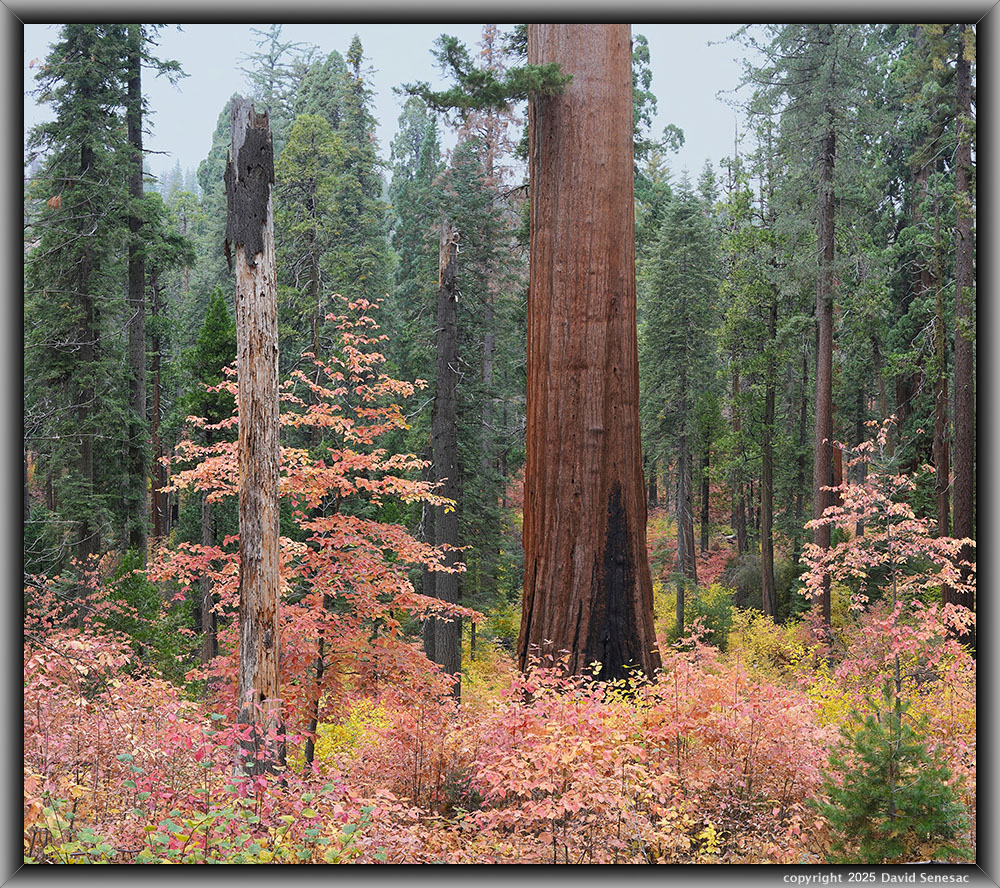
VB05292-05300-2x1v 6800x6000 pixels 2 column 1 row 2 frame 9 shot focus stack stitch blend a6700 30mm
enlarged vertical slice view image text section
NEXT: Page 8 Rancho San Antonio County Park
2025 Trip Chronicles: Contents
Calaveras Big Trees State Park 10/21
Calaveras Big Trees State Park 10/22
Stevens Creek County Park 11/12
Mount Madonna County Park 11/15
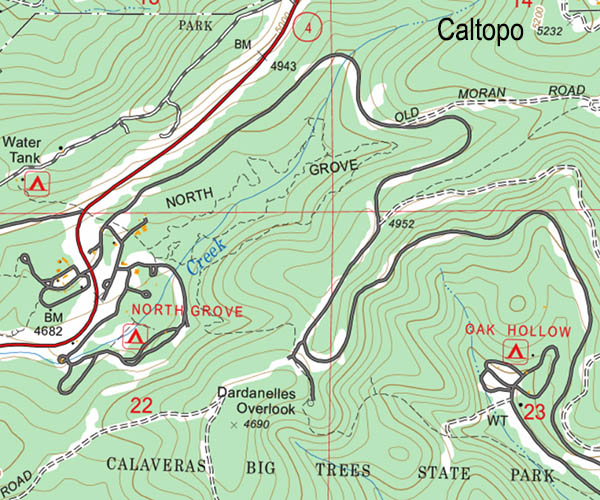
Five days after my eastern Sierra Nevada snow storm photography road trip, I was back on the road for more fall leaf work but on the west side of the range. Weather forecasts for days were showing the southern tail end of a front primarily moving through the Northwest, would provide a mostly cloudy day with light breezes Wednesday with some periods of minor rain that is necessary for my focus stack blending post processing. Temperatures were expected to be relatively mild, so no threat of snow. This was to Calaveras Big Trees State Park, famous for its giant sequoia trees that is our largest grove north of Kings Canyon. The park main facilities are at the 4680 foot elevation along highway SR4 with the main fall leaf species, Pacific dogwood that changes to a range of bright colors. So a mid forest elevation a bit below average winter storm snow levels.
I have worked the park a few falls in the past, however most of that work was early November view camera 4x5 film work, so is not something I can add to my website since drum scanning is at least $80 a transparency. Thus, early Tuesday afternoon October 21, 2025, well before commute traffic, I drove the 3+ hours and 160 miles to Calaveras Big Trees State Park. Paid for a $35 campsite at site #3 but would be sleeping comfortably in the back bed of my 2023 Trailblazer LS. I get plenty of tent time each year and prefer sleeping in the car during fall and winter. Had enough time to walk both the 1.5 mile North Grove Loop Trail that showed my timing was perfect for peak Pacific dogwood, aka mountain dogwood, Cornus nuttallii, leaf color. In fact, dogwood fall leaf color was the best I've yet seen there. The official state park brochure webpage:
Calaveras Big Trees SP brochure
I also hiked the South Grove Trail that was a dozen miles away. That remote grove is supposed have about 3000 big trees, however most are scattered about landscapes beyond views from the trails or fire roads. With the long night hours at this time of year, I was asleep early during the evening. In the wee hours looking out my window, I happily noted the stars had finally disappeared behind forecast moving in clouds. During nights, I usually sleep for 1 to 3 hours at a stretch while dreaming 100% of the time. So was awake early at dawn to set up my car and gear for a day of foul weather photography.
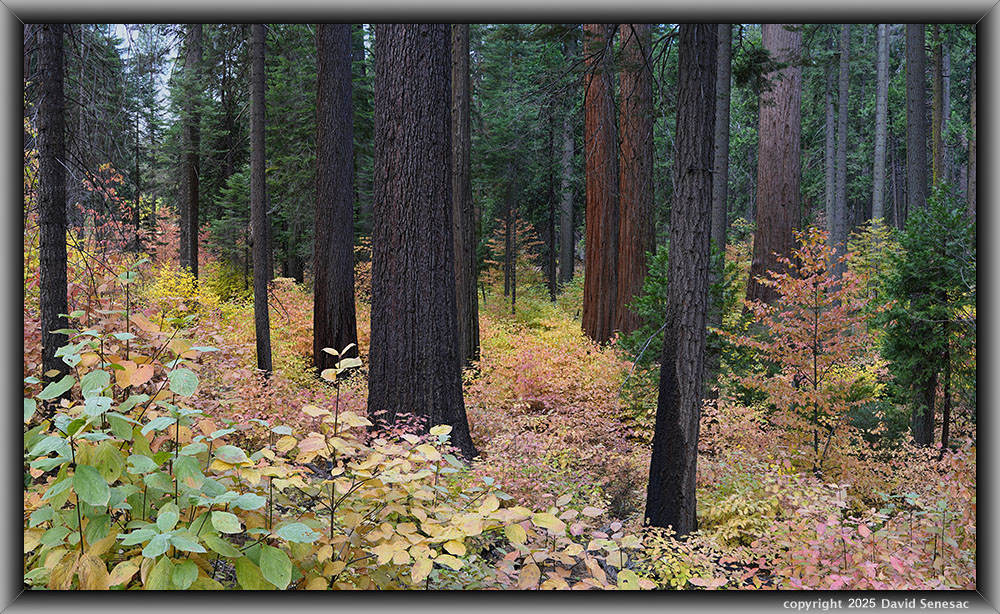
VB04969-05008-3x1v 10100x6000 pixels 3 column 1 row 3 frame 40 shot focus stack stitch blend a6700 30mm
enlarged vertical slice view
By 7:15am PST Wednesday afternoon October 22, 2025, I was working my first subject. I decided to start by taking the Overlook Grove Trail that provides better views down into the forest, versus the much more popular, North Grove Loop Trail that is rather level with incremental natural science information view points. And at 7:33am PST worked the second subject shown above, a 3 column 40 shot focus stack stitch blend using my Sigma 30mm prime at F5.0. Indeed at least early, had an optimal overcast sky plus dead calm. The above image shows the kind of colorful understory below most of the forest trees.
Unlike our related species, coastal redwoods, that tends to dominate its forests, giant sequoia, Sequoiadendrum giganteum, grow scattered in mixed mid elevation forests with many other species. In the above, besides 3 giant sequoia, are also sugar pine, Pinus lambertiana, ponderosa pine, Pinus ponderosa, and incense cedar, Calocedrus decurrens. Occasionally, the park during especially cold fronts, receives snowfalls in early November adding that aesthetic photography bonus. But by that time, the dogwood will be near their late leaf color stages, less colorful.
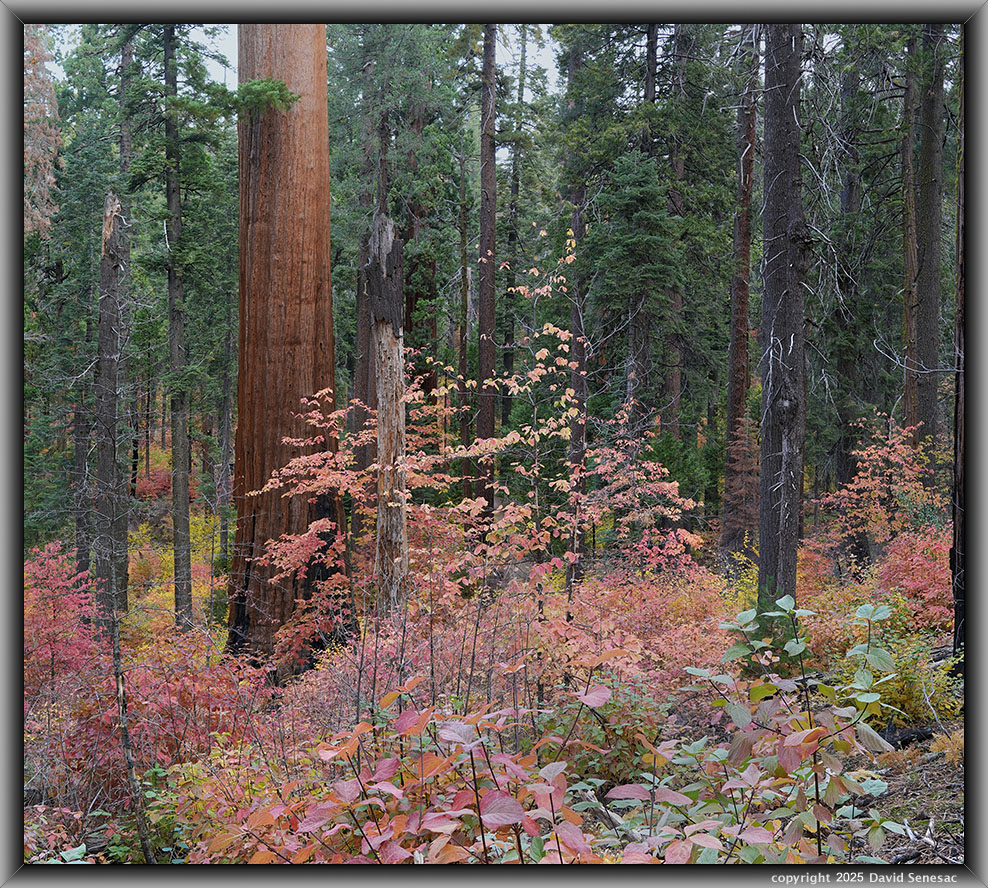
VB05026-05050-2x1v 10100x6000 pixels 3 column 1 row 3 frame 25 shot focus stack stitch blend a6700 30mm
enlarged vertical slice view
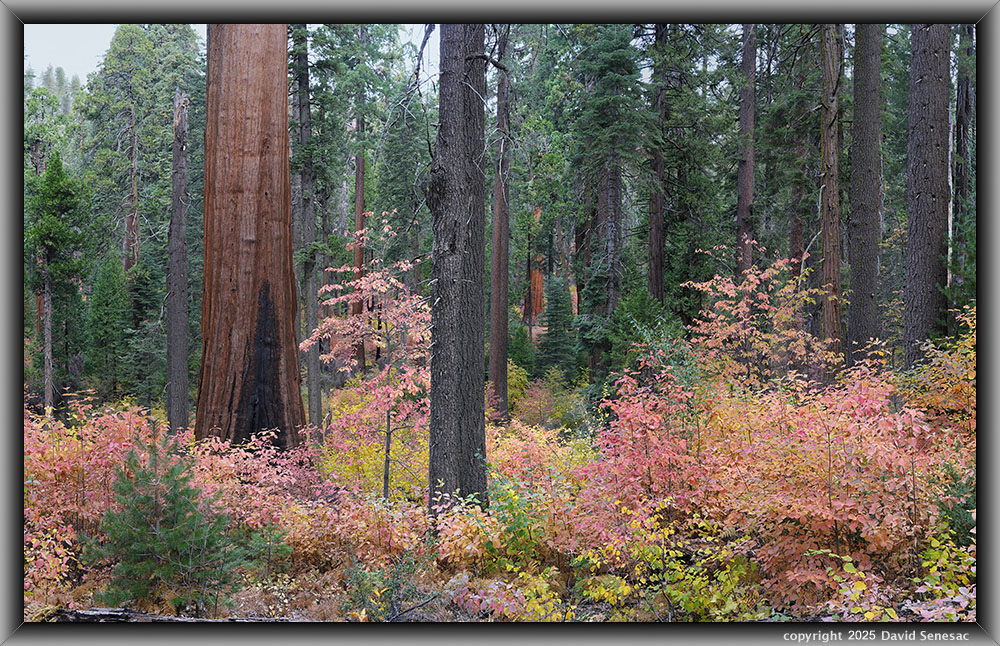
This next image above, is a 3 column 1 row 3 frame 25 shot, focus stack stitch blend that was shot at 7:55am PST. It also includes some white fir, Abies concolor, that when young make ideal Christmas trees. Notice the sequoia has only a single branch showing within this frame, as limbs of mature trees tend to be up high, above the level of any past wildfires burning its understories. The park has done an excellent job using controlled burns to clear areas of the forest, especially around these large trees. To the right of the sequoia is a barkless snag and to its right somewhat obscured is another large sequoia.
VB05051-05066-3x1v 9700x6100 pixels 3 column 1 row 3 frame 16 shot focus stack stitch blend a6700 30mm
enlarged vertical slice view
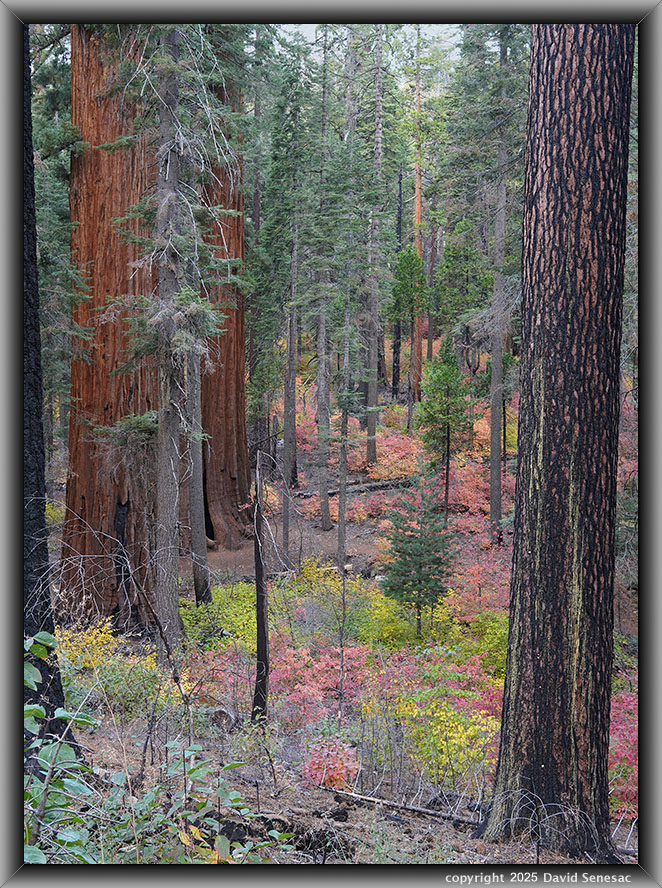
Another perspective of the same sequoia shot at 7:58am PST. The other background sequoia is now more visible as well as 2 others. The 2 trees at frame right are sugar pine while the third tree is an incense cedar that has somewhat similar foliage and sometimes has a similar reddish brown bark color. The way to tell the two apart, is the cedar's foliage is flat. Another smaller conifer species at the lower frame right edge is the uncommon Pacific yew that has red berries. Several may be found right beside the south section of the North Grove Trail.
VB05092-96 4100x5600 pixels 1 frame 5 shot focus stack blend a6700 30mm
enlarged vertical slice view
The above is a single vertical frame shot at 8:19am PS that shows part of the North Grove Loop Trail above where it passes by two sequoia. A burnt sugar pine trunk is a frame right that was quite alive with foliage higher up. Note the yellow sap flowing down its trunk, that the fire caused. Given its thick bark, giant sequoias are our most resistive to burning conifer. Looking at the enlarged vertical slice view, one can see some of its fallen pine cones, that are the largest cones in the world. The shrub with still very green leaves in the lower frame left foreground is also a dogwood, that shows the varied range in changing leaf color cycle even among near zone trees.
With many more good subjects on my list, a large area of blue sky, not in the forecast, ominously for my purposes, moved over the park. A minor breeze also developed that would crimp further work. After waiting a couple hours at a particularly spectacular part of the grove with its largest group of big trees, I gave up and began driving home. But after just driving west about 8 miles, I had a better open view of the sky that showed the blue sky was just in this region with clouds beyond in all directions. Given reception, I was also now able to use my old moto g smartphone to look at weather sites that showed the blue sky would pass with an afternoon that would cloud back up with some storms. Thus, turned around and drove back into the park. Modern electronic technology to the rescue! From there, I drove back out to the South Grove where I explored some areas I had not yet seen including the quite nice and fall leaf colorful Beaver Creek picnic area, I'll highly recommend during fall. And indeed by 11am clouds began moving in. Not only clouds, but I could hear plenty of thunder further east at higher elevations that was blanketed in stormy clouds.
VB05104-13 4100x6150 pixels 1 frame 10 shot focus stack blend a6700 30mm
enlarged vertical slice view
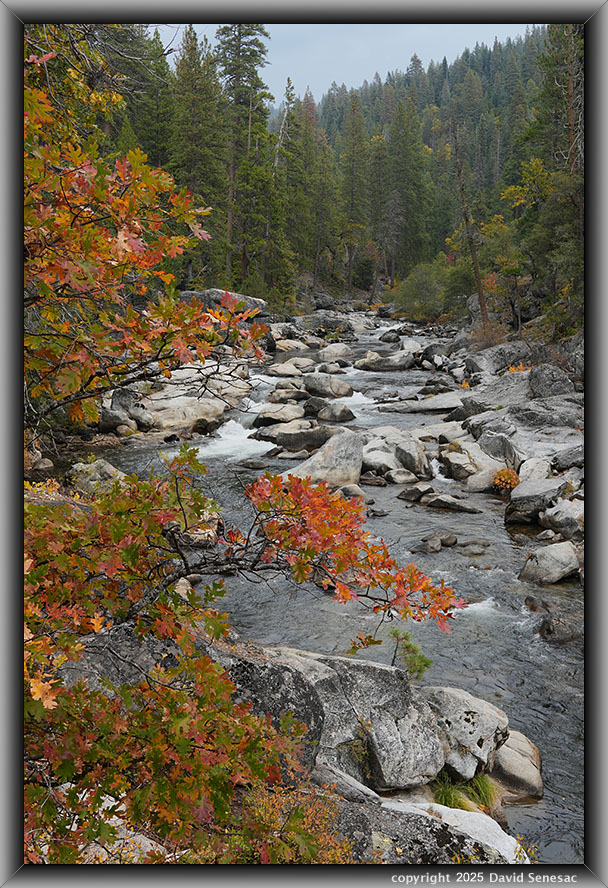
The sequoias grow near the north rim of the North Fork of the Stanislaus River that is 1000 feet lower at 3.6k feet. Another species with fall leaf color are black oaks, Quercus kelloggii. Leaves of most black oak only change to yellows, while a few trees also sport oranges and reds. At 11:39am PST, I worked the above oak leaf color along the river. Because the park forest has been protected for many decades and never logged, its forest conifers are some of the largest in the range, that this view up river readily shows. Looking at the enlarged vertical slice view, one can see a fisherman standing by a right side river pool. And his partner's rod is that dark line across the nearby bright granite boulder. Because the slight breeze jostled the oak leaves, post processing required about 6 hours of tedious manual Zerene Stacker to fix the mis-registrations. There are numbers of fine subjects along the river I hope to work in the future.
VB05170-05199-2x1v 5800x5800 pixels 2 column 1 row 2 frame 18 shot focus stack stitch blend a6700 19mm
enlarged vertical slice view
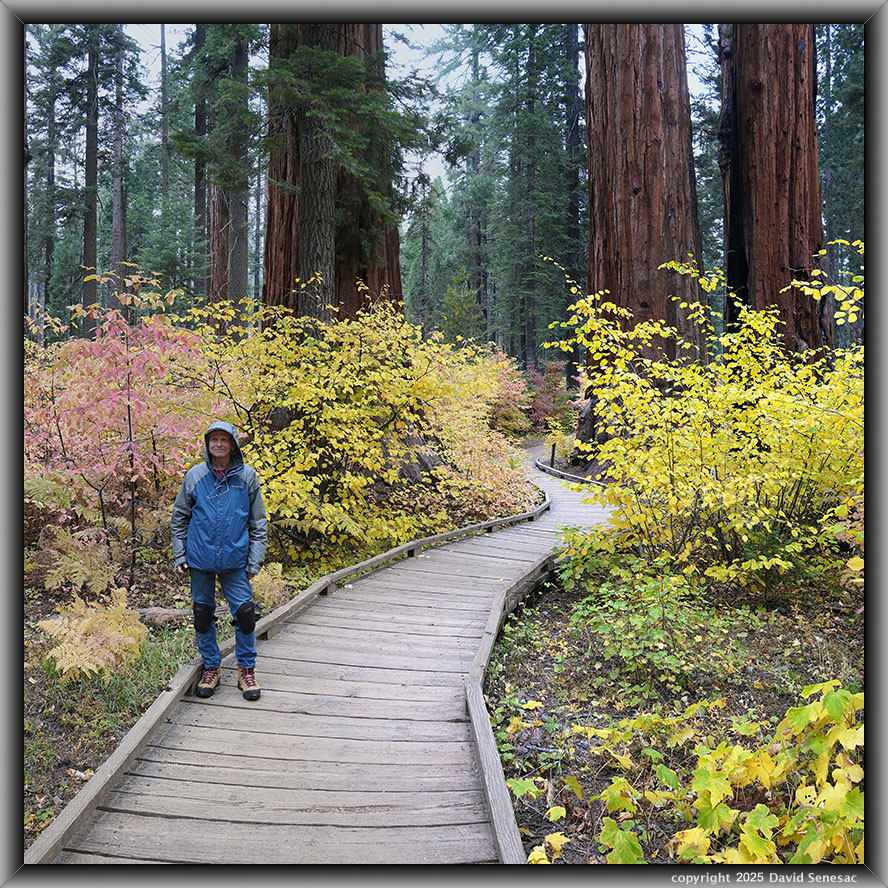
At mid day at 1:09pm PST as sprinkles enveloped the area while wearing rain gear, worked parts of the North Grove Loop Trail. The above subject, using my 19mm lens, shows parts of the boardwalk at the area of most dense big trees in the grove. At frame lower right are thimbleberry, Rubus parviflorus, whose fall leaves turn to a fine yellow and contain sparse, delicious red berries that taste a bit like raspberries. Beside my legs are some drying bracken fern, Pteridium aquilinum, that turn a light pastel yellow brown. These well constructed wood boardwalks, cover short sections of the trail where water during wetter times of year, covers expanses of this mid forest elevation basin.
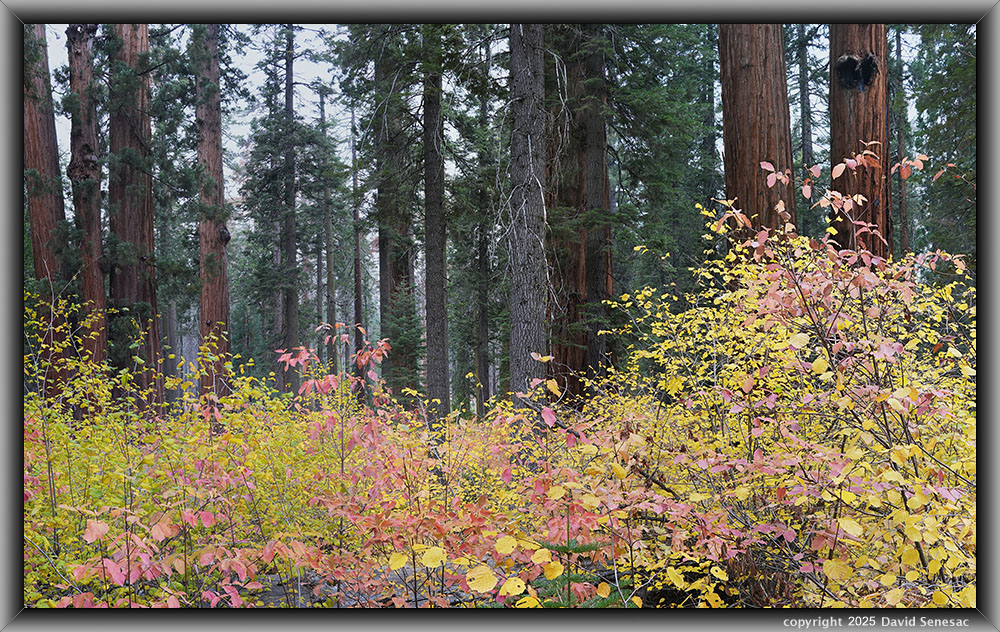
VB05240-05282-3x1v 5800x5800 pixels 3 column 1 row 3 frame 38 shot focus stack stitch blend a6700 30mm
enlarged vertical slice view
The above strong subject was one I had patiently waited near during the morning for at least an hour before giving up due to lack of clouds for diffuse skylight. But in the afternoon, between some significant showers that dropped about 1/3 inch of rain, at 1:37pm PST, was back with my camera and able to capture with my 30mm lens, the 3 column stitch blend of 38 focus shots. There was some breeze, that caused enough mis-registrations between focus stack shots that I spent about 5 hours tediously, manually fixing the result of dogwood leaf movement with Zerene Stacker. Time well spent with the bright dogwood leaf foreground in front of 9 giant sequoia in the background. Such dense groups of large sequoia are common in Sequoia National Park groves, far to the south but uncommon elsewhere in the north. The small conifer at center right frame bottom, is a white fir. And to be clear, it is only when these forests are under this kind of diffuse cloud light, that the color leaf undergrowth has such a magical quality. So no, don't visit during fall during much more common, harsh, contrasty, sunny conditions as the photographic images do not lie.
At page top I worked my last subject at 2:05pm PST, the same large sequoia as 2 other shots above. To frame left of the big tree, in the distance one can see the distinctive crowns of 3 other sequoias. The small tree at frame lower right is a ponderosa pine, Pinus ponderosa, also called western yellow pine that has been in several of the above frames. The large tree at frame left, is a white fir. Behind the dead snag, are several giant sequoia and rising above each of those in the misty cool humid air is a sugar pine that shows some of its long hanging pine cones.
Over the day, I had only had usable diffuse cloud skylight for a couple hours, so was frustrated leaving significant numbers of good subjects I just never had a chance for. But that just means, I am certain to return during some future fall.
On the periphery of a storm further north given diffuse cloud sky light and near calm breezes, late morning Wednesday November 12, 2025, visited Stevens Creek County Park, that is only 8 miles distance from where I live, for fall leaf work along Stevens Creek. That was primarily big leaf maple trees whose leaves are the only common coastal region tree species with prominent fall leaf color. The young, relatively low, Santa Cruz Mountains only rise to a bit above 3000 feet, but because of orographic rainfall from the adjacent Pacific Ocean, receives considerable more rainfall than near sea level San Francisco Bay urban areas, that supports cool, shady, mixed woodland, redwood forests. Areas east of the shielding range crest like this, are much less foggy.
Stevens Creek County Park website
At this fall time of year along coastal California mountains, many deciduous trees entering dormancy have lost leaves while herbs above ground growth has died away, drying. Balancing that loss of green, especially close to streams and about shady northern exposures, are mosses, fungi, and small rising from seed annual herbs. This creates a more visually open woodland forest, with dense areas of bare branches. Although I identify some plant species in the text below, there are other herbs and shrubs in each image I have not yet been able to that is primarily a matter of leaf shapes and arrangements. Our coastal region also has over 100 species of bryophytes that includes mosses and over 700 species of fungi, that require considerable training to identify.
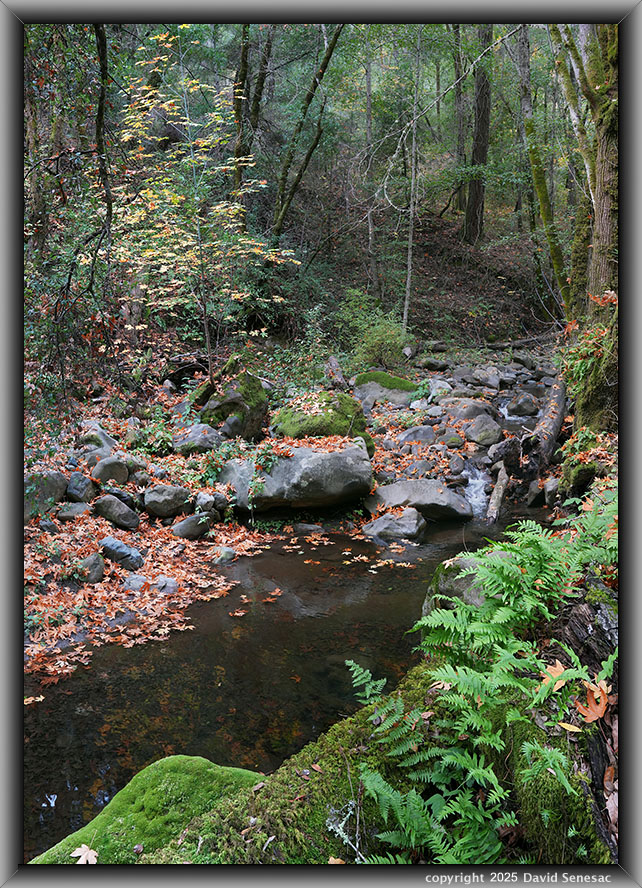
VC05345-05392-2x2v 6300x8900 pixels 2 column 2 row 4 frame 46 shot focus stack stitch blend a6700 30mm
enlarged vertical slice view
A bit before noon, I worked this first modest subject above, a 2 column 2 row, 4 frame stitch blend of 48 focus stack blended shots. Stevens Creek, with a small big leaf maple, Acer macrophyllum tree and many of its fallen, drying, turned orange-brown leaves below. Also in the background are tanbark oak, Notholithocarpus densiflorus, and California bay laurel, Umbellularia californica. At foreground lower right are coastal wood fern, Dryopteris arguta, and moss covered rocks with a fallen branch with greenshield lichen, Flavoparmelia caperata. In the background are blackberry, Rubus sp., that are common everywhere along the stream. Stream rocks are sedimentary sandstone and mudstone often with a darker dried organic surface. This type of complex winter woodland subject works best using a camera/lens system capable of high detail.
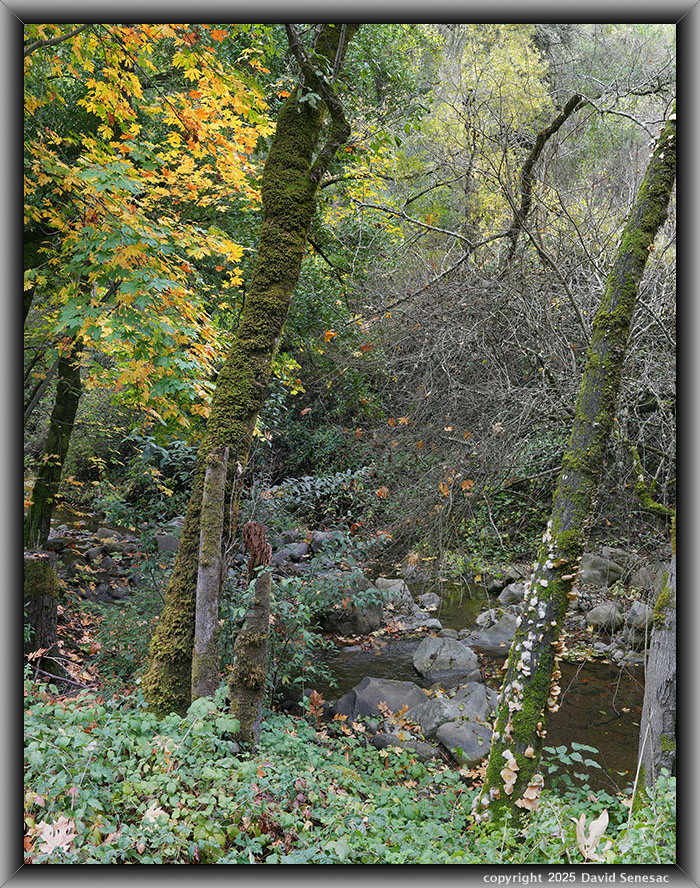
VC05393-05430-2x2v 7300x9400 pixels 2 column 2 row 4 frame 27 shot focus stack stitch blend a6700 30mm
enlarged vertical slice view
My second subject above, also a 2 column by 2 row 4 frame stitch blend of 7300 by 9400 pixels, was the strongest image of the day with big leaf maple leaves at peak fall color. In the foreground are blackberry. The left of center moss covered tree, showing a few green leaves at frame top, is a box elder, Acer negundo and the tree with mushrooms and fungi is probably too. That fast growing, easily attacked by fungi, species only lives for about 75 years maximum. Also at frame top, are leaves of an evergreen California bay laurel whose strong leaf fragrance tends to dominate these landscapes. At frame right above the stream, are dense bare tangled branches of a California buckeye, Aesculus californica with a few of its buckeye fruiting balls still showing.
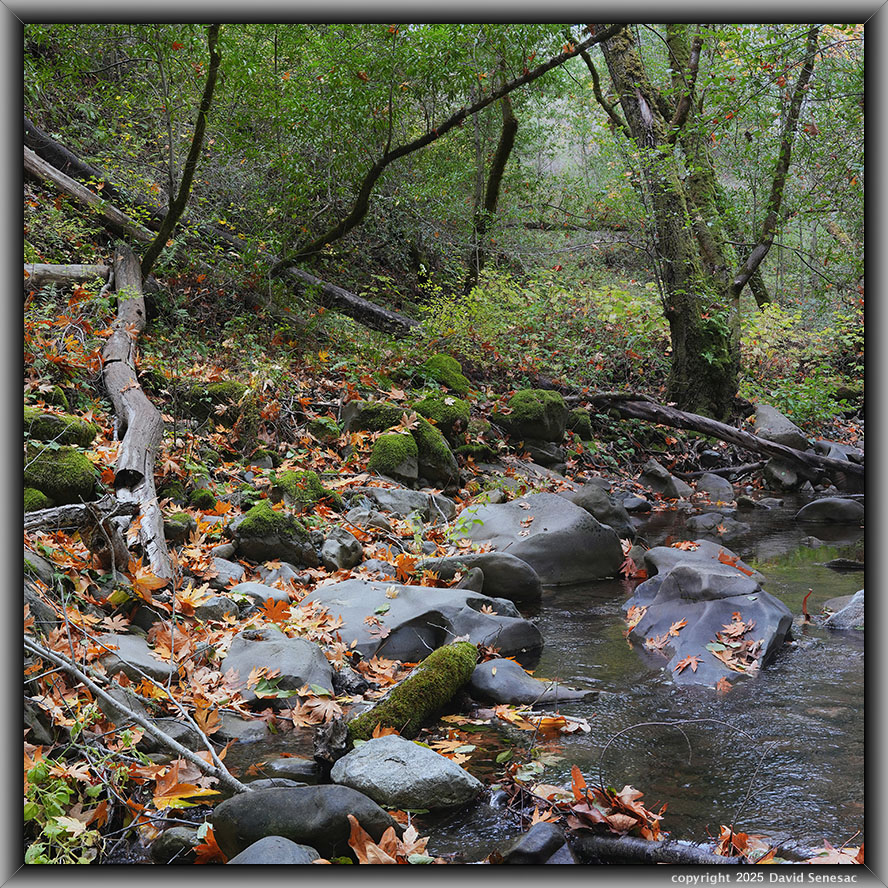
VC05432-05457-2x1v 9900x6100 pixels 2 column 1 row 2 frame 26 shot focus stack stitch blend a6700 30mm
enlarged vertical slice view
Another Stevens Creek subject with big leaf maple, California bay laurel, blackberry, thimbleberry, Rubus parviflorus, and snowberry, Symphoricarpos albus. Again, most fallen leaves are from big leaf maples. The box elder at frame right center has coastal wood ferns growing out of its trunk that is common. Notice how smooth boulders within the stream channel lack moss while those a bit higher above frequent flood eroding levels are green.
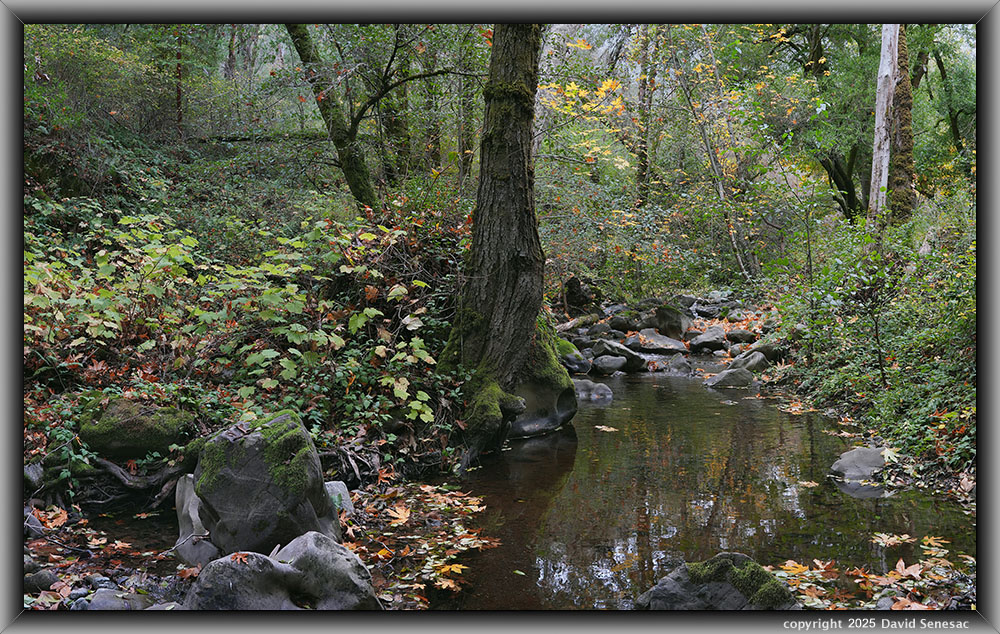
VC05458-05484-3x1v 6100x6100 pixels 2 column 1 row 2 frame 26 shot focus stack stitch blend a6700 30mm
enlarged vertical slice view
And another Steven Creek quiet reflecting pool with the same species. The plants frame mid left are a mix of lighter thimbleberry and darker blackberry.
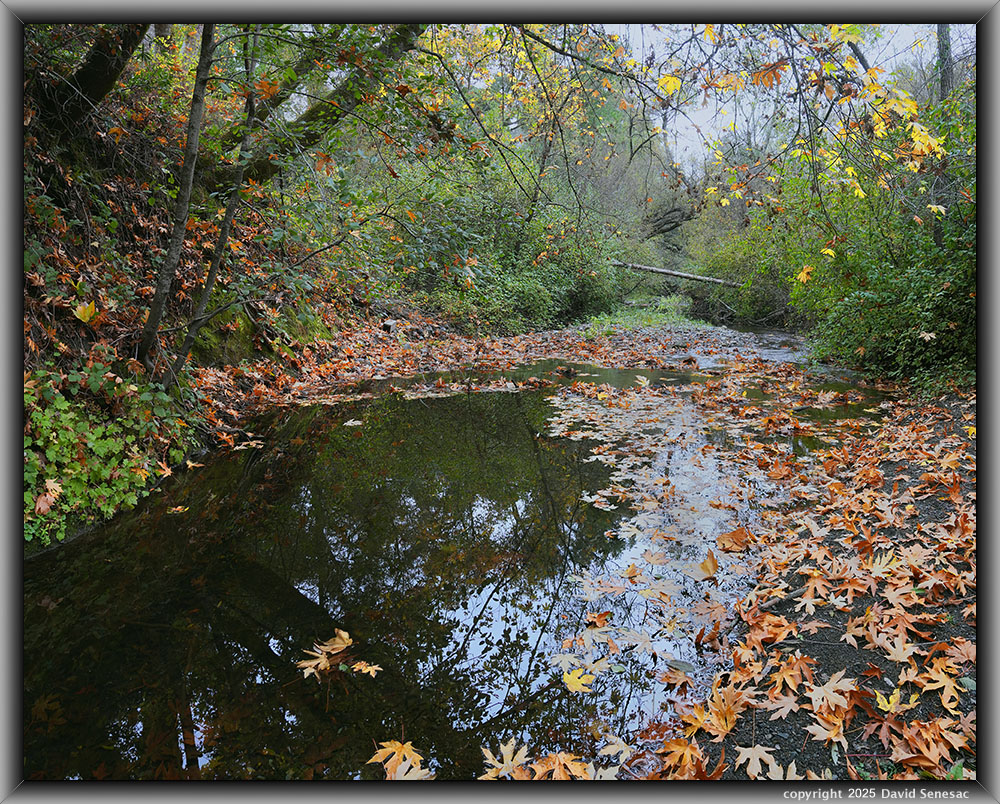
VC05485-05518-3x1v 7300x5800 pixels 3 column 1 row 3 frame 34 shot focus stack stitch blend a6700 30mm
enlarged vertical slice view
This reflection pool just above where the creek enters Stevens Creek reservoir, was my last subject on this increasingly cloudy day with mist falling. At frame right are red ozier dogwood that are common in the area. Interestingly, few show colorful fall leaf colors like its same species Sierra Nevada shrubs. This is within the city of Cupertino where I went to kindergarten and first ever fished in the reservoir.
Early morning Friday November 15, 2025, on a day with increasing light rain showers, drove 40 miles south to Mount Madonna County Park in the Santa Cruz Mountains, that I've never before visited in order to explore for some more big leaf maple with fall leaves subjects.
Mount Madonna County Park website
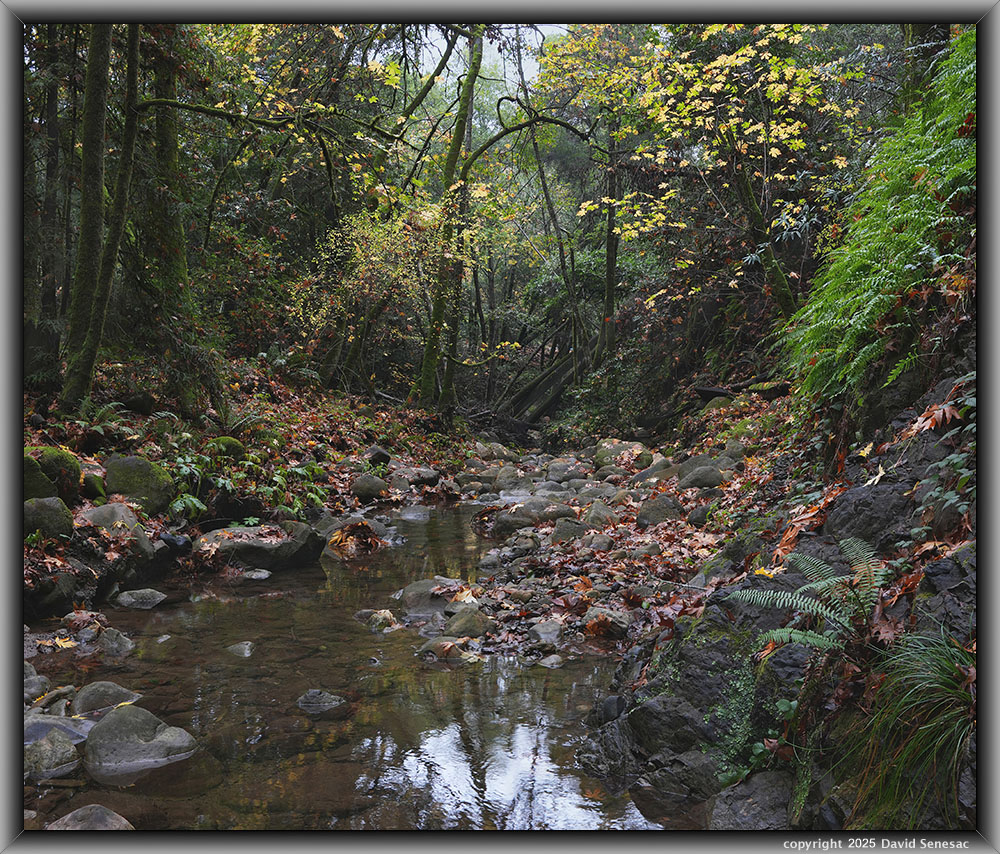
VD05519-05540-2x1v 7200x6100 pixels 2 column 1 row 2 frame 22 shot focus stack stitch blend a6700 30mm
enlarged vertical slice view
For the first time hiked with my new free standing umbrella that has a back harness. Landscapes had similar plants to that of the previous section on Stevens Creek. The above landscape along small Bodfish Creek, had big leaf maple, coast redwood, Sequoia sempervirens, California bay laurel, black cottonwood, Populus trichocarpa, sword fern, and coastal wood fern. Streambed area boulders were quite slippery walking about.
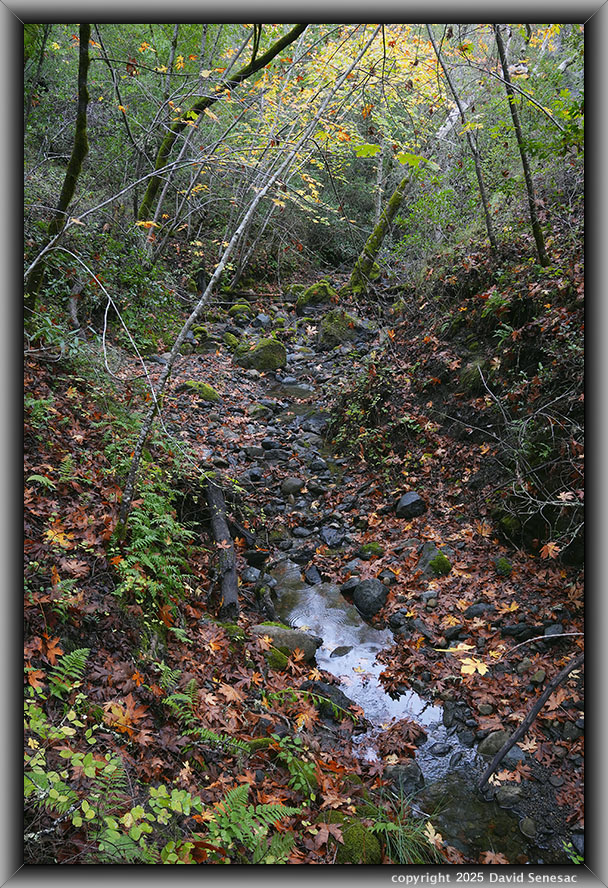
VD05565-76 4100x6150 pixels 1 frame 22 shot focus stack blend a6700 30mm
enlarged vertical slice view
Near the bottom of the Ridge Trail worked the above 30mm lens single frame image with big leaf maple, coast live oak, Quercus agrifolia, California bay laurel, blackberry, snowberry, and coastal wood fern. Note the rain drops rings in the stream pool.
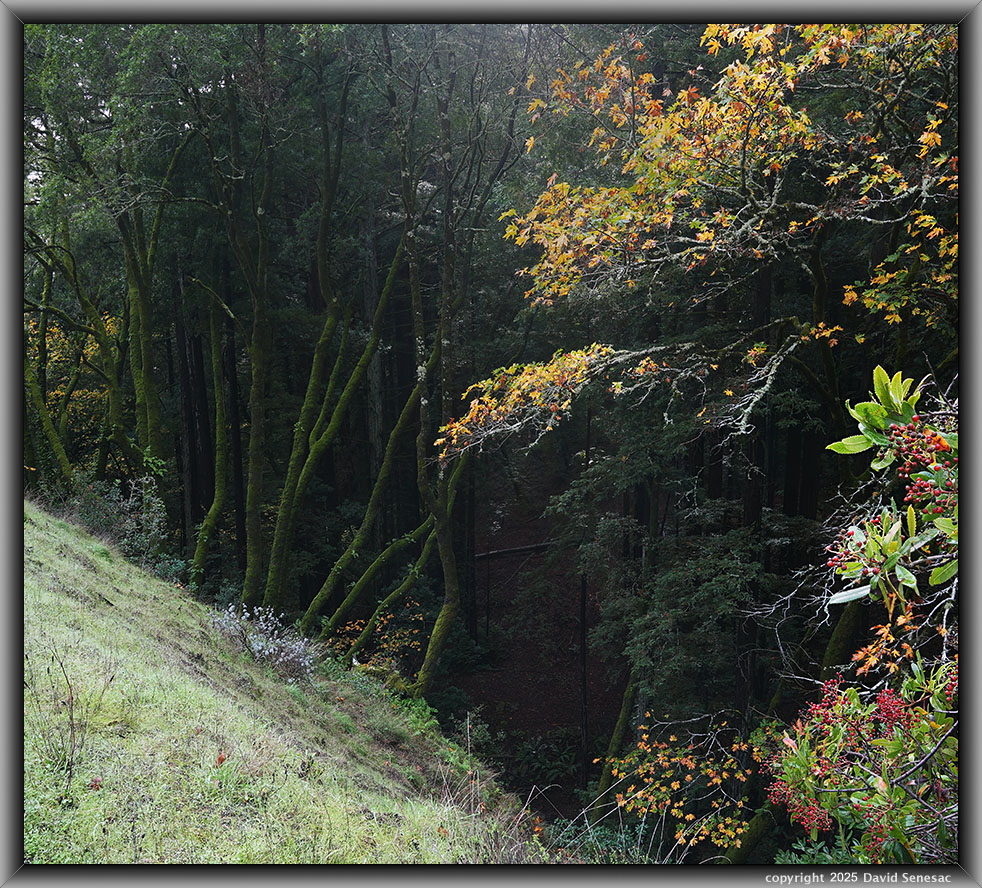
VD05577-05611-1x2h 5900x5300 pixels 1 frame 22 shot focus stack stitch blend a6700 19mm
enlarged vertical slice view
Along the Ridge Trail where it meets Blackhawk Canyon, worked the above with at frame right toyon, Heteromeles arbutifolia, and its red berries, plus big leaf maple, coast redwood down in the shadows, California bay laurel, tanbark oak, coastal wood fern. The light green, wet, new grass growth has a whitish cast.
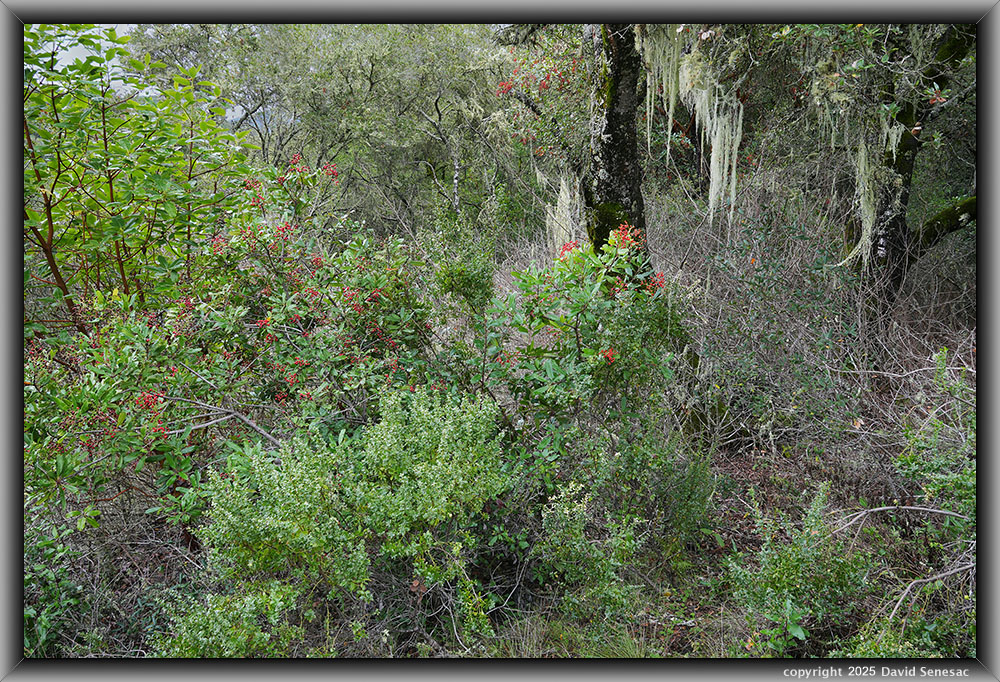
VD05640-50 5700x3800 pixels 1 frame 22 shot focus stack blend a6700 30mm
enlarged vertical slice view
Another shrub/tree with red berries and smooth orange bark, Pacific madrone, Arbutus menziesii, plus coastal wood fern, snowberry, and greenshield lichen. Have not ID'd the two plants in the foreground including the one with blooming white flowers, or the probable willow species at frame upper left with much greenshield lichen. The two frame right trees with lace lichen, Ramalina menziesii, are tanbark oaks. Oddly, poison oak was uncommon in this zone though traveling through trailless areas would require constantly barging through dense thickets. In open areas, were numerous fresh soil mounds from gophers.
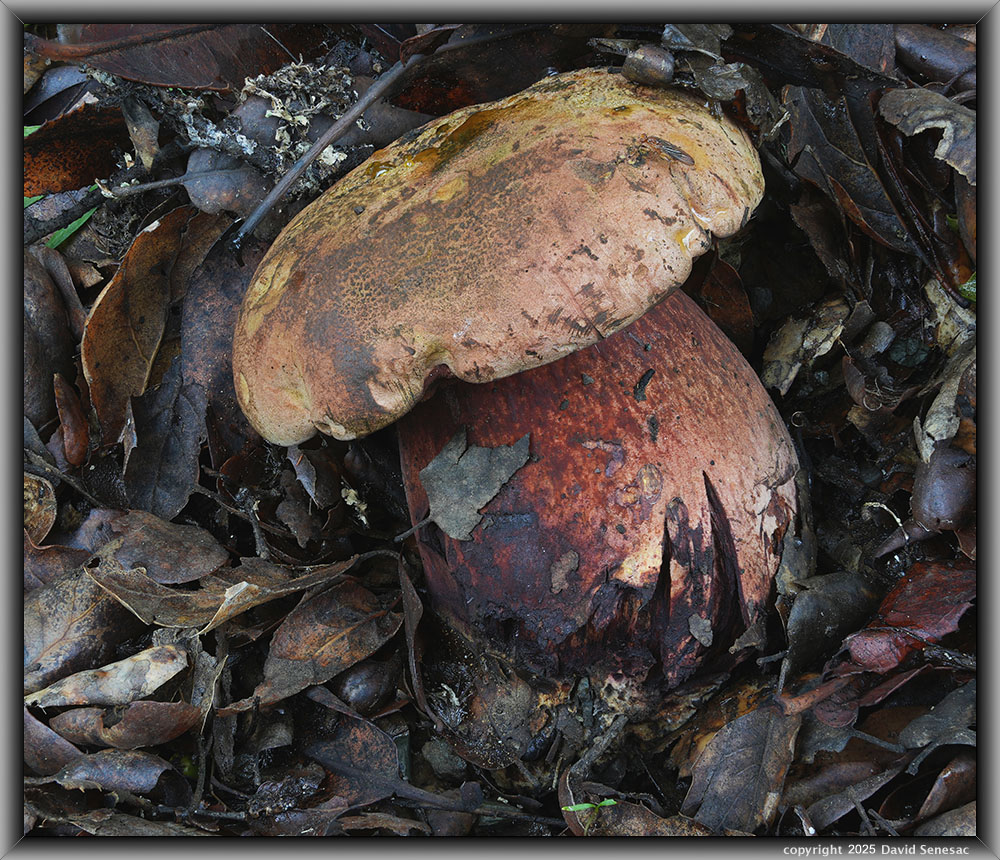
VD05660-09c 4800x4100 pixels 1 frame 50 shot focus stack stitch blend a6700 30mm
enlarged vertical slice view
My final subject this day about 1pm, was the above bolete family mushroom rising up from damp, decaying leaf matter showing its vast world of micro-organisms at work during this damp wet season time of year. Note the resting fly with a rusty red head.
NEXT: Page 8 Rancho San Antonio County Park
2025 Trip Chronicles: Contents

















