RY01449-61 6000x4000 pixels 1 frame 13 image focus stack blend A6000 30mm
enlarged vertical slice view image text section
NEXT: Page 6 Glen Alpine Creek Basin Backpack
2018 Trip Chronicles: Contents
Mono Basin 6/11
Evergreen Road 6/12
Evergreen Road 6/13
During May, inland slider storms continued to move across Oregon down the back side of the Sierra Nevada into the Nevada Great Basin with considerable winds, thus keeping me away. Three weeks after my earlier Mono Basin road trip, the first extended period of fair weather brought me back. Thus, on Sunday, June 10, at midday, I drove across the range on SR120. In the afternoon, I drove south on US395 and explored some areas of sand flats where I found monkeyflowers and dwarf lupine in low numbers. Late afternoon, stopped for a burger at the Mono Cone and a pepperoni pizza slice at the Mobile Mart before driving down to Mono Lake, where I tented at the location I had used on May 13, except that I had my new Big Agnes Copper Spur HV UL tent, and set that up on pumice/obsidian sands with a view of the lake.

RY00816-00854-4x1v 12600x6000 pixels 4 frame 4 column 1 row 39 image focus stack stitch blend A6000 60mm
enlarged vertical slice view
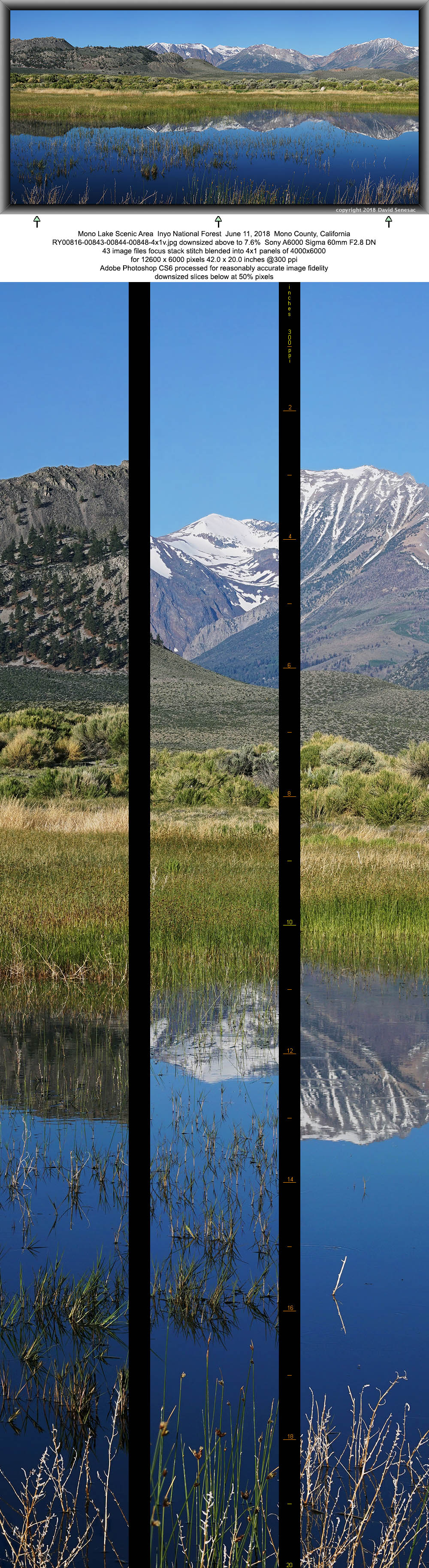
Monday dawn, June 11, 2018 with sunny skies above, I drove the short distance to the east Navy Beach parking lot and, as the sun moved down the slopes of the Sierra Crest, rambled east along the sand tufa and rabbitbrush to the marsh pond I had worked on my earlier trip. There I took shots for the above panorama towards Mono Craters. In the background, there was still a modest amount of snow on Mt Wood, Mt Lewis, and Mt Gibbs while the landscape was generally green for nice aesthetics.

RY00861-00884-3x1v 9400x4400 pixels 3 frame 3 column 1 row 24 image focus stack stitch blend A6000 60mm
enlarged vertical slice view
Continuing east along the shore, I noticed that, unlike a month earlier, there were large numbers of alkali flies that seagulls were now actively feeding on. As was the case on my earlier trip, there were soon no human footprints on the sands, reflecting how few people ever walked along the shores more than a mile east of the very popular South Tufa. I stopped at a sand spit pond to take the above reflection image with snow-adorned Mt Gibbs, Mt Dana, and the Dana Plateau rim in the background. South Tufa itself is tiny at the right frame edge. Panum Crater is in front of Mt Gibbs.

RY00886-00922-5x1v 15300x4400 pixels 5 frame 5 column 1 row 37 image focus stack stitch blend A6000 60mm
enlarged vertical slice view
After a fair distance, one comes to the second significant tufa outcrop beyond South Tufa at a couple of miles. There I set up this sand spit pond for another modest reflection image. A group of seagulls was relaxing atop the narrow spit, providing reflections too. In the background, frame left is Mt Warren and, at center, Dunderberg Peak. At frame left in the background is a black cinder cone on Paoha Island. Note the rather smooth lake waters reflecting only mild breezes at mid-morning. I was pleasantly surprised to find no mosquitoes or black flies which were a nuisance during my earlier trip. With rising temperatures and drier landscapes, mosquitoes had moved into lower Sierra Nevada areas.

RY00943-00974-3x1v 9100x6000 pixels 3 frame column 1 row 32 image focus stack stitch blend A6000 60mm
enlarged vertical slice view
Another nice feature along these remote shores was areas of sand dunes without any footprints. Thus, I moved to a position in the morning light at 8:45am PDT off to the left, where sand wind ripples stood out best. These volcanic sands are mostly pumice and obsidian. In the distance are Mono Craters, Mt Wood, and snowy Kuna Crest.

RY00975-00997-3x1v 9100x6000 pixels 3 frame column 1 row 23 image focus stack stitch blend A6000 30mm
enlarged vertical slice view
And per above, I then turned towards the northwest direction for another image across the dunes with Mono Lake in the background. Notice how green these rabbitbrush are; that indicates that just below the sands, their roots are down into the cap rock layer above, through which groundwater flows towards the lake. In the distance, frame left, are Mt Warren and Dunderberg Pk, while at mid-frame is Paoha Island.
Further east, it was impossible to walk along the shore edge due to increasing marshy areas. Sand spits were underlain with marshy material that would not support walking on. In one spot I sank to my knees, and there were other likely bottomless spots. Additionally, inland were larger areas of marshes interspersed with drier clumps of rabbitbrush. I had studied the areas with Google Earth, but route finding had to be done visually at ground level. I managed to get about 4 miles down the shore into areas no other person would ever likely venture. I found a spring at the base of tufas with a surprisingly strong flow that fed into a large marsh very active with life. Birds like swifts were all about eating flying insects while blackbirds were continually making their calls. There were also some larger birds including geese and an ibis. By noon I had turned at quite a distance inland, and then slowly made my way back west across unpleasant soft sands. By the time I reached the Forester, I had probably walked about 9 miles and was rather weary.

RY01199-05 3500x5300 pixels 1 frame 7 image focus stack blend A6000 19mm
enlarged vertical slice view
Instead of spending more time in the Mono Basin, I had seen enough to move on, and I planned to return west on SR120, through Yosemite where I would dabble along the way, and out to the Evergreen Road areas. At 7540 feet in the Yosemite Creek canyon, the highway passes a nice early-season cascade with a paved pull-out. It is also an excellent spot to fill up water bottles and wash car windows as water overflows along the street. In order to slow the shutter speed down to 1/5 to 1/3 second, I set the aperture to a small F16 to F18, thus losing resolution, which is why I reduced the image size.

RY01211-21 5000x4000 pixels 1 frame 11 image focus stack blend A6000 60mm
enlarged vertical slice view
At bedrock roadside slabs along SR120 at 7920 stopped for this late afternoon shot of peaking mountain pride penstemon, Penstemon newberryi, great red paintbrush, Castilleja miniata, and sticky cinquefoil, Potentilla grandulosa. I continued west, out of the park, then east on Evergreen Road in Stanislaus National Forest, where I parked at a familiar spot to overnight.

RY01227-35 6000x4000 pixels 1 frame 9 image focus stack blend A6000 60mm
enlarged vertical slice view
Tuesday dawn, June 12, 2018 I was up and out to a favorite location for roadside flowers at Ackerson Meadows. The breeze was light as I set up to shoot the above dense patch of dew-covered Sierra calicoflower, Downingia montana.

RY01279-89 5500x4000 pixels 1 frame 11 image focus stack blend A6000 60mm
enlarged vertical slice view
The area had lots of madia, Madia elegans, so setup this close-up of that included pretty face, Triteleia ixiodes, and one valley tassels.

RY01290-04 4000x5900 pixels 1 frame 15 image focus stack blend A6000 60mm
enlarged vertical slice view
A mile east along the road, stopped for this Brewer's lupine, Lupinus breweri, a short height species. Note the white with yellow patches on the petals, which indicate to insects that the flower has not yet been pollinated. After pollination, that patch turns purple.

RY01305-16 4200x3800 pixels 1 frame 12 image focus stack blend A6000 60mm
enlarged vertical slice view
Forest areas had numbers of western blue flag, Iris missouriensis, so I walked about until finding this optimal specimen with nice balance and color. Traditionally, with cameras, the very 3-dimensional iris species are generally difficult to image closely due to limited depth of field; however, focus stacking has no such issue, allowing capture of much more full flower detail.

RY01317-33 5000x4000 pixels 1 frame 17 image focus stack blend A6000 60mm
enlarged vertical slice view
Just east of where Evergreen Road crosses the Middle Fork of the Tuolumne River, are patches of the large fragrant western azalea, Rhododendron occidentale. The species is common along larger streams at this lower forest elevation. With no breeze, I found a nice clump of flowers above.

RY01346-54 4400x4000 pixels 1 frame 9 image focus stack blend A6000 60mm, extension tube
enlarged vertical slice view
Another species with traditional depth-of-field difficulty is the butterfly mariposa lily, Calochortus venustus, due to its deep flower bowls. Again, the unlimited depth of field with focus stacking allows capturing fine intricate details of the full flower. Note the reddish-brown with yellow glands on each petal that distinguishes this species.

RY01408-10 6000x4000 pixels 1 frame 3 image focus stack blend A6000 SEL55210 @109mm
enlarged vertical slice view
By mid-afternoon, breezes made additional close-up work impossible. I drove back into the park and then hiked out to an area behind Pywiack Dome I wanted to explore. Except I managed to leave some gear in the car, so I hiked back. Then, driving back west, stopped for a view of Cloud's Rest above. Back out of the park, I drove to a familiar dirt road spot to overnight along Mather Road.
On Wednesday, June 13, 2018 , I waited till the Camp Mather gate into Yosemite opened at 7am and then drove to a favorite area of granite slabs. For the image at the top , I came upon an interesting complex of live forever, Dudleya cymosa, jewelflower aka shieldleaf, Streptanthus tortuosus, and gone-to-seed wooly sunflower, Eriophyllum Linatum, growing up through a skeleton of dead manzanita branches. And on the old wood are patches of frog-green-hued wolf lichen, Letharia vulpina.

RY01462-67 3500x5000 pixels 1 frame 6 image focus stack blend A6000 60mm extension tube
enlarged vertical slice view
There were many more subjects than I was able to capture because a breeze had once again come up, making focus stacking difficult. I hunted about in areas where the breeze was somewhat blocked. With patience, I was able to capture the above beautiful Mariposa clarkia, Clarkia biloba.

RY01468-76 4000x5400 pixels 1 frame 9 image focus stack blend A6000 60mm, extension tube
enlarged vertical slice view
Another subject I was able to capture was this pretty elegant brodiaea, Brodiaea elegans, backlit in morning sunlight against a shadowed boulder.

RY01477-90 3600x5300 pixels 1 frame 14 image focus stack blend A6000 30mm
enlarged vertical slice view
Next is the tangled mix of Mariposa clarkia and wooly sunflowers.

RY01511-22 6000x4000 pixels 1 frame 12 image focus stack blend A6000 30mm
enlarged vertical slice view
Finally, beside a small meadow stream, shot at an acute angle across a dense patch of backlit slender tarweed, Madia gracillis, with a light-hue version of purple owls clover, Orthocarpus purpurascens, and common monkeyflowers. By noon, I was on the road home. My work in the Mono Basin was not as productive as expected; however, I was able to capture nice close-ups for a number of familiar species out in the Mather area.
NEXT: Page 6 Glen Alpine Creek Basin Backpack
2018 Trip Chronicles: Contents